
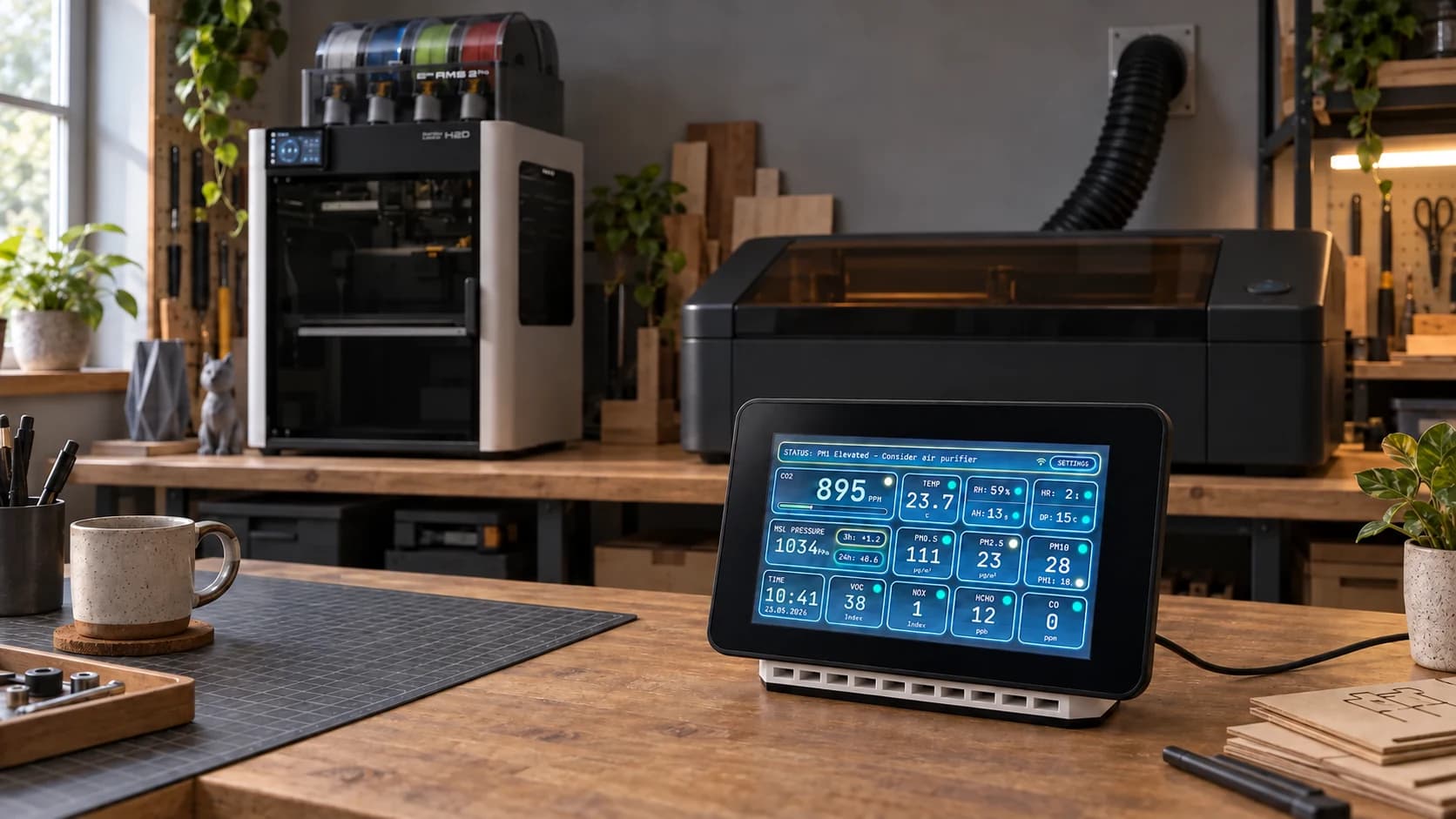
I recently ordered some alder plywood from Ukraine at a good price. When I cut it with the laser, the formaldehyde reading on my Aura AQ screen rose to 100–110 ppb. With the Bambu Lab plywood I use, that reading stays around 20–30 ppb, close to what I usually see in the room.
The readings came from my DFRobot SFA40 sensor. It reports formaldehyde (HCHO) in ppb, or parts per billion: one part of gas in a billion parts of air by volume. The lower figure is my usual room reading, not a safety threshold.
A good price is easy to compare. What a sheet releases when a laser cuts through it is harder to see on a product listing.
The cut edge is the result we can inspect. Some of the material removed along that edge has become airborne particles and gases, and extraction needs to carry them away before they spread through the room. The monitor helps us notice what reaches it, within the limits of its sensors.
The laser cuts through the glue, too
“Alder plywood” tells you something about the wood. It tells you much less about what holds the layers together. Plywood is a bonded product, and some of the resins used in composite wood contain formaldehyde. The laser works through those layers and their adhesive together. EPA: Plywood, adhesives and formaldehyde
These were workshop observations, not controlled tests of the sheets. I do not know which adhesives they contain, so I cannot attribute the rise to a particular glue.
I have seen a similar contrast with other plywood. The Bambu Lab sheets I have used give much smaller VOC rises than unbranded plywood from building-supply shops. With those unbranded sheets, I have also seen formaldehyde-reading spikes. A material's composition and suitability for laser cutting deserve a place beside its price on the shopping list.
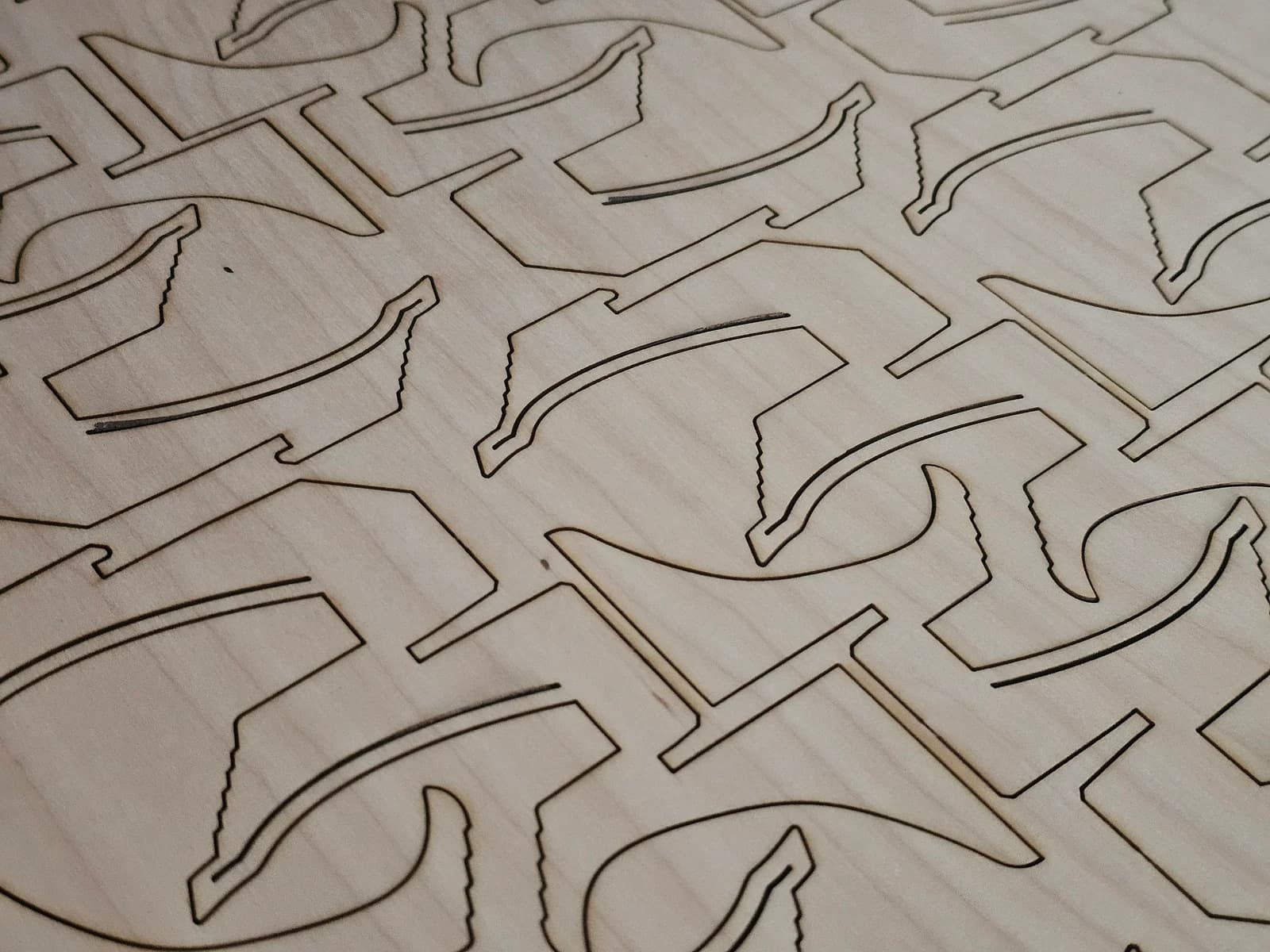
The reason this matters extends beyond plywood. Along a laser's cutting line, material is heated intensely enough to break down and be removed. Some of it enters the air as gases and tiny suspended particles. VOCs, or volatile organic compounds, are a broad group of gaseous chemicals; PM readings describe the particle side of the mixture. A rise in one does not require an equally large rise in the other.
Cardboard makes an interesting test of our intuition about familiar materials. In an experiment with a desktop CO₂ laser, it produced higher particle concentrations than the tested wood, plastic or glass. Wood and cardboard also released VOCs and carbon monoxide. Exhaust reduced the average measured particle mass concentration inside the machine by 61%, but did not remove the particles completely. That percentage describes the study's machine chamber, not a promised improvement in someone's room. Even these everyday materials needed effective extraction. Desktop laser emissions study
There are reasons to reduce what reaches our breathing space. Formaldehyde can irritate the eyes, nose and throat. Some other VOCs can cause irritation, headaches or nausea, depending on the substance, concentration and length of exposure. A rise during cutting is a reason to investigate the material and extraction. EPA on formaldehyde, EPA on VOC exposure
Carbon monoxide adds a different concern: it interferes with the blood's ability to carry oxygen. It is a separate gas from CO₂ and needs a dedicated CO sensor; a VOC reading cannot stand in for it. Health Canada on carbon monoxide
Material identification comes before the first cut. For example, a clear sheet is not necessarily acrylic: PVC can release hydrogen chloride when laser processed and should not be laser cut. Use identified material approved for the equipment. The laser cannot check the supplier's description for us. MIT laser cutter guidance
The quiet graph beside a PLA printer
Against that background, my 3D-printing experience seems almost uneventful. I mainly print PLA and have not noticed the same response on the monitor that I see during laser cutting.
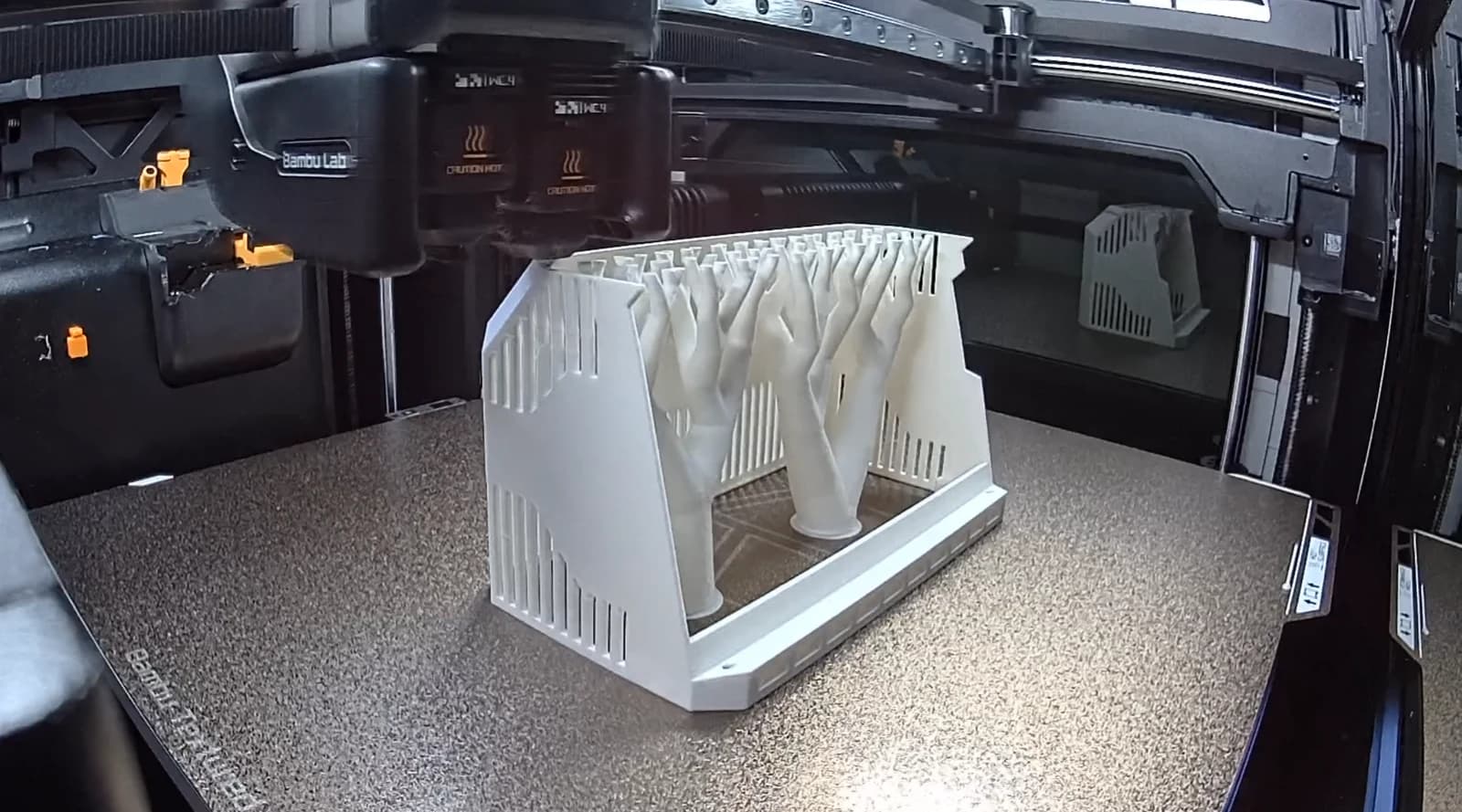
There is encouraging evidence for PLA, or polylactic acid. In a study comparing several printers and filaments, the tested PLA setups emitted far fewer ultrafine particles than the setups using ABS, another plastic used for 3D printing. Both still released particles and VOCs. Filament printer emissions study
The nozzle temperature can change that picture. In one tested PLA setup, raising it from 230 to 240 °C caused a sharp rise in measured ultrafine-particle concentration. For your own prints, avoid unnecessary heat and choose a suitable temperature within the filament manufacturer's recommended range. Nozzle temperature and particle emissions
But the quiet graph has another explanation worth understanding. A PM sensor does not see every particle a printer can make.
On the monitor, a PM2.5 reading describes particle mass in a volume of air. It is not a headcount. Imagine two spherical particles of the same material, one ten times wider than the other: the larger one has a thousand times the mass. A crowd of very small particles can therefore contribute little to the mass reading.
Size also determines whether the sensor can measure them at all. The SEN66 used in Aura AQ specifies a particle-size range beginning at 0.3 micrometres, or 300 nanometres, for its PM mass outputs. Ultrafine particles are smaller than 100 nanometres. They sit below that specified range, so this sensor cannot count the ultrafine particles discussed in the printing study. SEN6x datasheet, section 1.2
My quiet graph could reflect low concentrations reaching the monitor, particles outside its measurement range, or both. My observation alone cannot separate them.
Inhaled particle pollution can reach deep into the lungs, irritate the airways and aggravate asthma. That is a reason to include ventilation in the printing setup even when the room looks clear. EPA on particle pollution
I also stick with PLA manufacturers I trust and avoid cheaper alternatives. I have not compared air-quality readings between PLA brands.
When the machine stops, the air keeps moving
With the laser, I see VOC rises, sometimes a higher formaldehyde reading, and a smaller PM rise. The response seems especially noticeable when the CO₂ laser is cutting acrylic. The end of the cut is another moment worth watching.
In an acrylic-cutting study, extraction kept methyl methacrylate gas close to the lowest concentration the instrument could detect. Common acrylic, PMMA, can release this compound as it breaks down under heat. Opening the lid still released particles, including ultrafine particles. Acrylic laser-cutting study
It is easy to think of the enclosure as a box holding a finished part. It also holds air. Lifting the lid changes how that air mixes with the room.
Allowing time before opening gives extraction a chance to remove what remains inside. There is no single delay that fits every machine, and a monitor elsewhere in the room cannot tell you that the air inside the enclosure has cleared.
Resin printing carries the same idea further. The progress bar reaches 100%, but the job moves to the wash station. A part wet with isopropyl alcohol still has to dry, and the solvent that leaves its surface enters the air as vapour.
In a study following the resin-printing workflow, researchers measured the highest total VOC concentrations during washing and drying with isopropyl alcohol, above those measured during printing. Resin-printing workflow study
Give the washing and drying area suitable extraction too, and close solvent containers between uses. Uncured resin can also irritate skin or cause sensitization, an allergic response that develops after exposure. Follow the resin and solvent safety data sheets for handling and protection. NIOSH 3D-printing guidance
Clearing the enclosure, washing the print and closing the solvent bottle belong to finishing the job too.
Give the emissions a route out
Once you follow the material into the air, extraction becomes easier to picture. The aim is to collect emissions close to where they are released, before they spread through the space where you work.
For an enclosed machine, room air enters the enclosure and carries contaminants towards the exhaust. The fan needs replacement air coming in, and its installed performance depends on ducts, bends and filters. Check airflow using the extraction system's specified method. Follow the duct to its outlet as well: discharged air should not return through a window or air intake, or expose other people. HSE guidance on local extraction
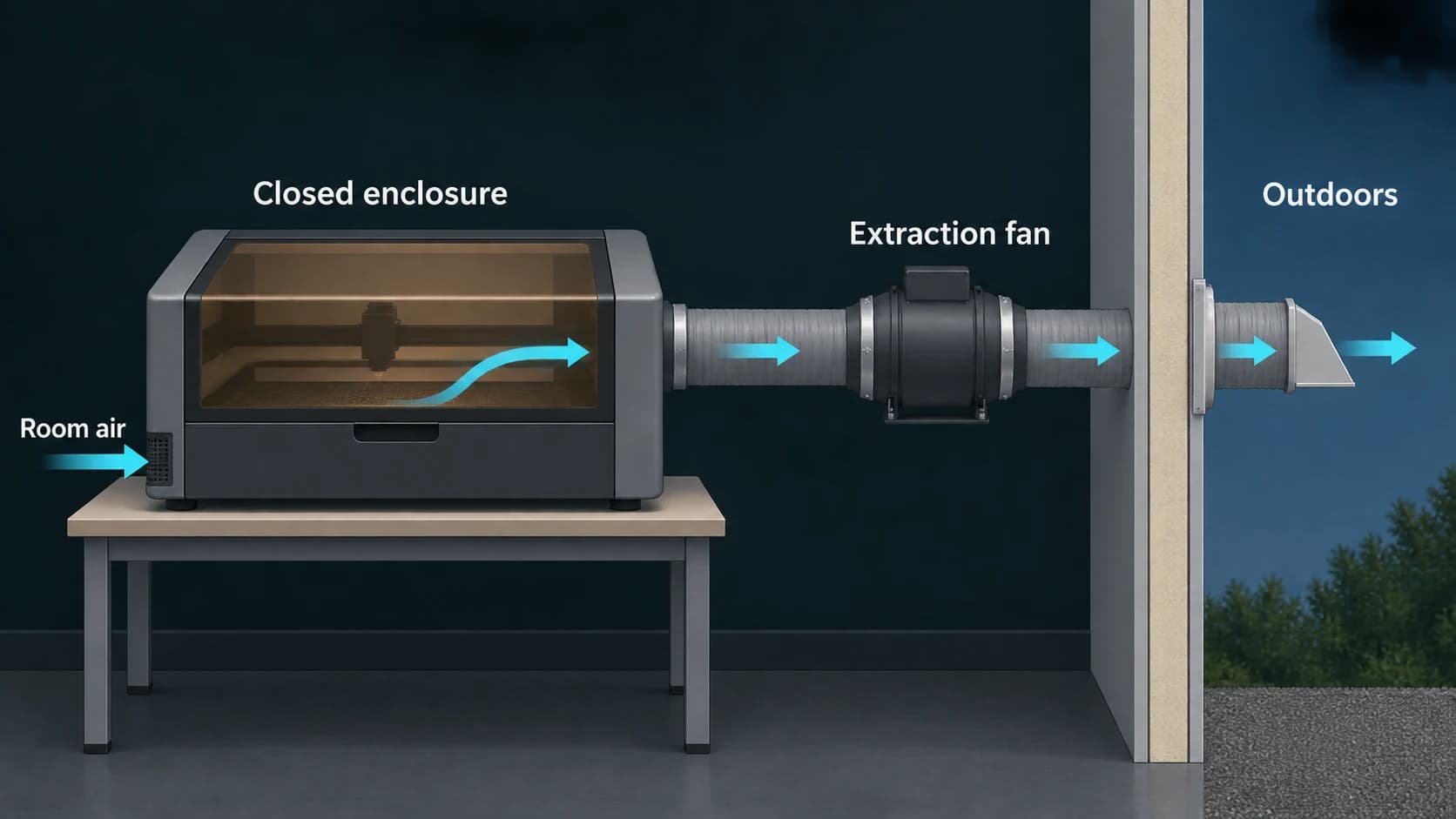
A fan blowing across the room can move emissions past your workbench. Source extraction tries to collect them before they get that far. General room ventilation helps with air exchange, but it cannot by itself show that the machine's emissions are being captured.
Filtration brings us back to those tiny particles the monitor can miss. A HEPA filter can catch particles below 0.3 micrometres; that familiar rating is not a set of holes through which everything smaller escapes. Air molecules knock very small particles around, increasing their chances of meeting a filter fibre and sticking to it. This is diffusion. Detecting a particle and capturing it are different jobs, which is why a sensor's lower measurement limit does not set a filter's lower capture limit. EPA on HEPA filters, EPA filtration research
Gases need suitable gas-filter media. Activated carbon holds some gases on its large internal surface through a process called adsorption. Its capacity is finite, and different compounds are retained differently. The media must suit the contaminants and be replaced as required.
Formaldehyde is one reason to look beyond the word “carbon” on a filter label. Ordinary activated carbon is not especially effective against it. For HCHO, look for filter media with documented performance for that gas; a thin carbon sheet alone is no assurance of removal. EPA technical guide to air cleaners
This matters especially when an extractor returns air to the room. Whatever it fails to remove comes back with that air. Check what the complete system is designed to control and keep up with its maintenance; the words “HEPA and carbon” alone do not establish that it suits a particular laser or printing process. HSE review of recirculating extraction
Read the graph alongside the job
With the plywood, the higher HCHO reading appeared during cutting. To investigate a change like that, start with what was happening in the room.
Keep the monitor in a consistent position where you work. Note the material, settings, start and finish times, and when the enclosure opens. For resin, include washing and drying. A monitor inside the machine or in a stream of fresh air describes different conditions from one beside the workbench. Monitor placement guide
Look for timings that repeat. A rise during cutting is a reason to check capture while the machine operates; a rise on opening points towards the clearance procedure. These patterns give you questions to investigate with the equipment supplier. Observe with extraction and other controls operating, and keep a running laser attended. MIT laser cutter guidance
The meaning of the numbers matters too. A VOC Index of 100 means the sensor's learned background, not 100 ppb of a particular gas. It cannot identify individual chemicals, and its background adapts. A familiar value during prolonged exposure therefore does not prove the original air conditions have returned. Sensirion's VOC Index explanation
For HCHO, Sensirion specifies typical SFA40 accuracy of ±20 ppb or ±20% of the reading, whichever is larger, for formaldehyde in otherwise clean air under specified test conditions. The plywood readings are useful observations, but cannot establish an exact emissions ratio between the sheets. SFA40 datasheet, section 1.1
CO₂ gives ventilation context where people are its main source, but solvent can evaporate without a matching CO₂ rise. HSE on CO₂ monitoring
Aura AQ can support this log with room PM, VOC Index and CO₂ readings, plus HCHO through the optional sensor. Identifying gas mixtures or counting ultrafine particles requires suitable instruments. Room readings alone cannot establish that the workshop is safe.
Keep making things
None of this means we have to give up laser cutting at home, let alone 3D printing. It means giving materials, extraction and ventilation the same attention we give the machine itself. The space needs to support the process, the filters need maintenance, and the machine still needs to be used and supervised as its manufacturer requires.
With the alder plywood, I got an attractive price and a much higher HCHO reading during cutting than I see with the Bambu Lab sheets. I do not yet know enough to explain the difference. For the next material purchase, though, there are useful questions to take beyond the price and wood species: what holds the sheet together, is it intended for laser cutting, and can the extraction handle the work?
We put a lot of thought into the objects we make. The air around them deserves some of that attention too.