
Your CO₂ monitor says 1,400 ppm. What does that actually mean?
A practical guide to indoor CO₂: what ppm tells you about ventilation, why bedrooms climb overnight, where 1,000 ppm came from, and what to do next.
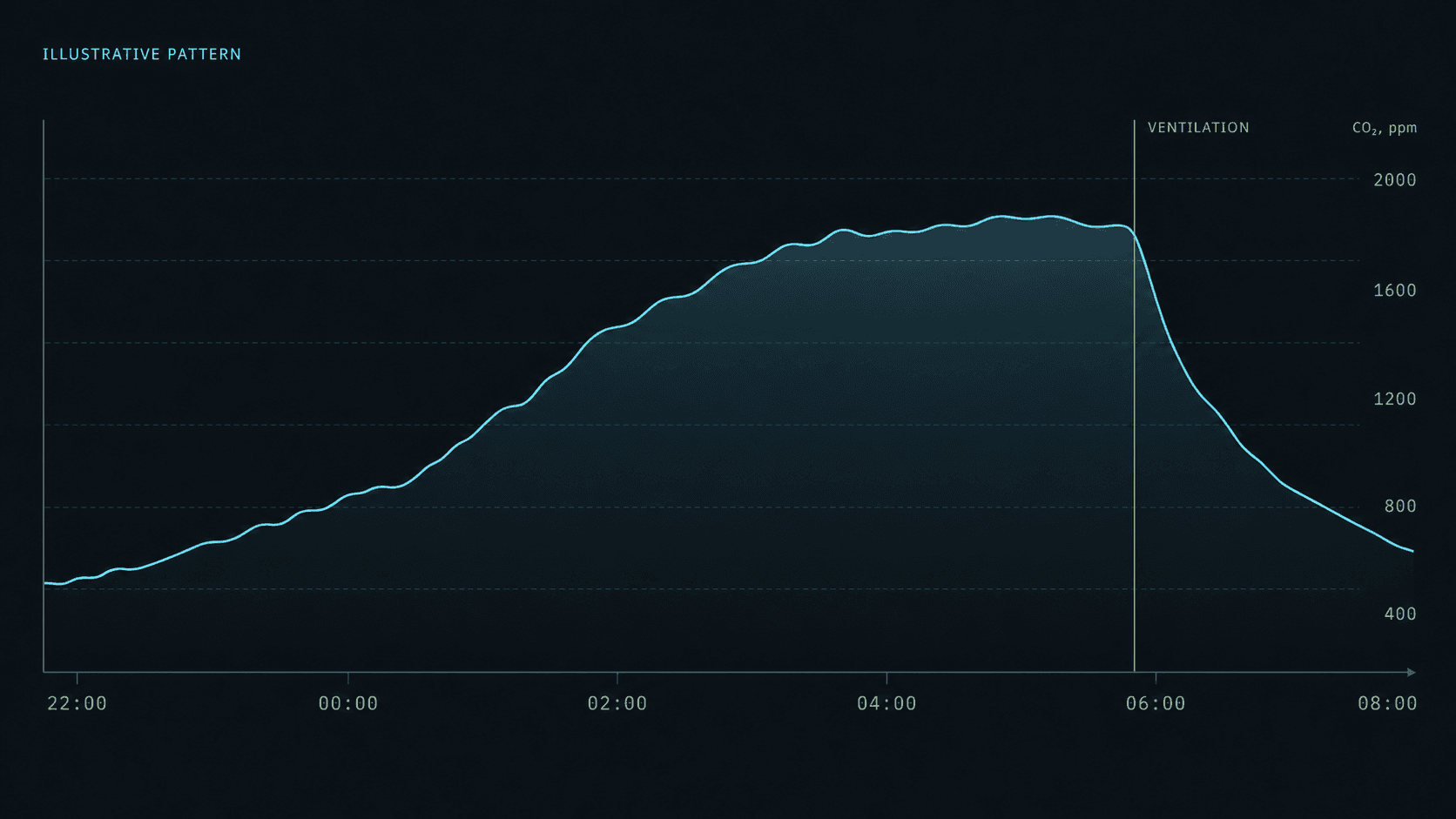
You close the bedroom door, go to sleep, and wake up to a graph that climbed all night. Nothing broke. Two sleeping humans simply kept adding CO₂ to the room while the room was not replacing the air quickly enough.
Indoor CO₂ works best as a clue about the balance between people and outdoor-air ventilation. It is a poor universal “air quality score,” and it is not a toxicity alarm.
Rising CO₂ usually means ventilation is falling behind the room.
A value such as 1,400 ppm is a reason to check the trend, occupancy, and available outdoor air. There is no magic cliff where safe air suddenly becomes dangerous. CO₂ also cannot tell you whether smoke, PM2.5, formaldehyde, VOCs, or carbon monoxide are present.

First, what does ppm mean?
ppm means parts per million. At 1,000 ppm, roughly 1,000 out of every million air molecules are CO₂. That is 0.1% by volume.
NOAA’s global measurements put current outdoor background CO₂ at roughly 430 ppm, although the value beside a road, in a dense city, or near a combustion source can be higher. Indoors, people add CO₂ every time they breathe out. Cooking with gas, candles, fires, and some work processes can add more.
In a normal occupied room, the graph often tells you more than one isolated number:
- a steady climb means the room is accumulating exhaled air;
- a plateau means the source and ventilation have reached a rough balance;
- a drop after opening a window or increasing mechanical ventilation shows that outdoor air is replacing indoor air;
- a sudden spike may simply mean someone breathed directly onto the monitor.
A practical way to read the number
There is no single worldwide traffic-light table that turns indoor CO₂ into a universal safe/unsafe verdict. Building type, occupancy, activity, outdoor concentration, and ventilation design all matter.
The ranges below are a practical reading guide. They are not a medical or legal standard.
| Reading | Practical interpretation in an occupied room |
|---|---|
| Near outdoor background | The room may be empty or receiving plenty of outdoor air. It does not prove that particles or gases are low. |
| Around 800–1,000 ppm | Common in occupied, reasonably ventilated rooms. Watch the trend and the room context. |
| Around 1,000–1,500 ppm | Ventilation may be losing ground. Check occupancy and look for a practical way to add clean outdoor air. |
| Consistently above 1,500 ppm | The UK HSE treats this as an indication of poor ventilation in an occupied room and recommends action. |
| 5,000 ppm | A workplace exposure limit used in industrial hygiene, not a sensible target for a home, classroom, or office. |
The word consistently matters. One brief peak beside a person is different from a bedroom remaining above 1,500 ppm for hours.
Why 1,000 ppm is not a toxicity cliff
The famous 1,000 ppm number has been repeated so often that it sometimes looks like a law of physics. It is not.
ASHRAE explains that indoor CO₂ has often been misinterpreted. A concentration near 1,000 ppm can be useful in ventilation calculations under specific assumptions, but ASHRAE Standard 62.1 does not establish it as a universal health or toxicity limit.
The number still earns its place on the dashboard because it adds ventilation context. A room that repeatedly rises well above its usual occupied level is telling you something. The monitor is giving you evidence, not a diagnosis.
What about headaches, sleepiness, and cognition?
Real-world studies often find that higher indoor CO₂ travels with more complaints or lower performance. The awkward part is that a poorly ventilated room does not accumulate pure CO₂ alone. It also accumulates heat, humidity, odours, human bioeffluents, and pollutants from materials and activities.
Humidity needs its own reading alongside CO₂. The indoor humidity and dew-point guide explains what relative humidity can tell you about room conditions and condensation.
Controlled studies that isolate CO₂ have produced mixed results at concentrations commonly found indoors. A critical review of 37 studies found the evidence inconsistent and often affected by confounding factors. The honest conclusion is less dramatic than many charts online: high indoor CO₂ is a useful warning that ventilation may be poor, while the direct effects of CO₂ itself at ordinary indoor concentrations remain an active research question.
If a room feels stale and the graph has been climbing for three hours, you do not need to win that scientific debate before opening a window.
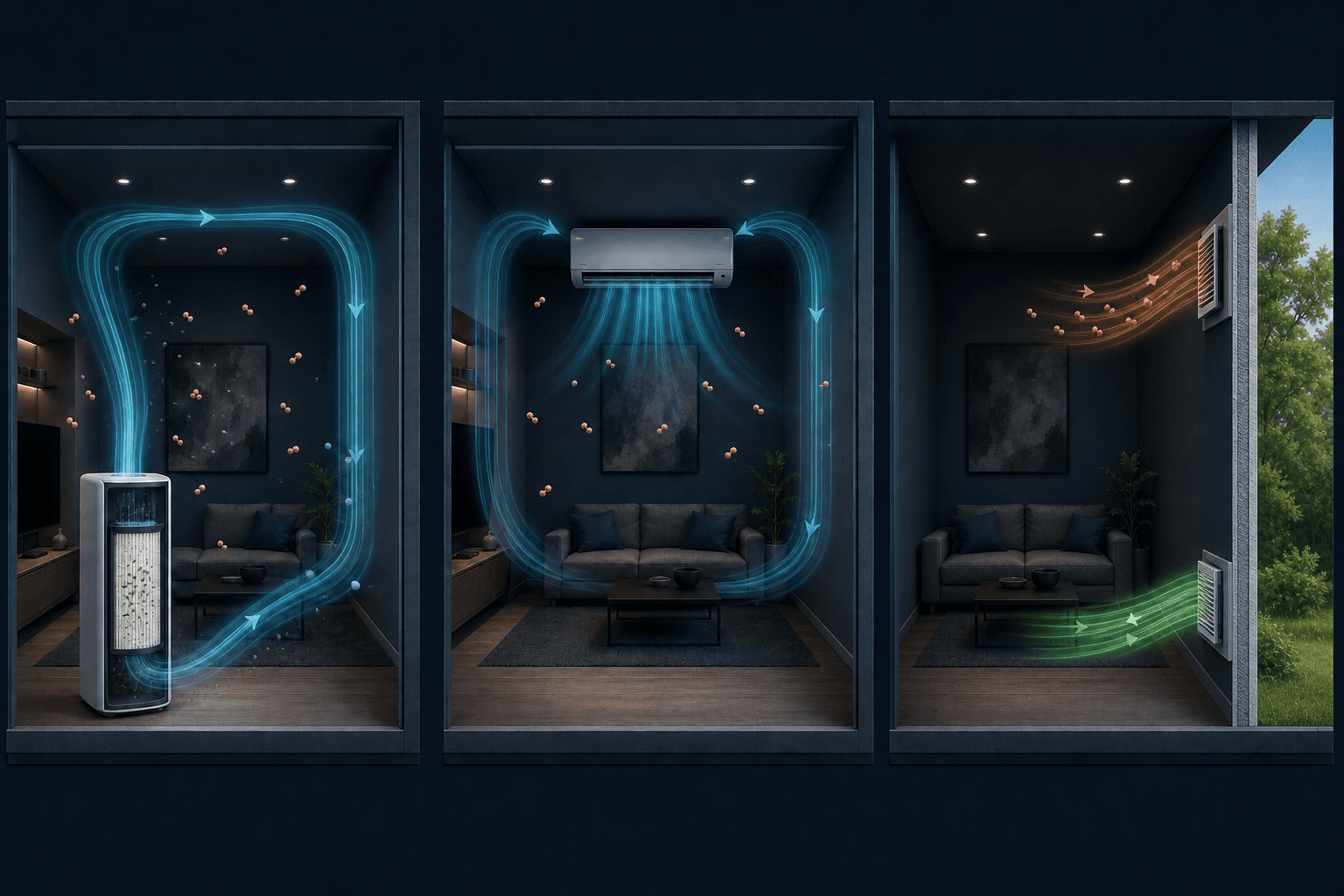
Why a purifier does not fix CO₂
A particle purifier can be excellent at removing smoke, dust, pollen, and other airborne particles. It usually does not remove CO₂.
A typical split air conditioner also recirculates indoor air. It changes temperature, and perhaps filters some particles, but does not automatically bring in outdoor air.
To lower CO₂, the room needs actual air exchange:
- open a window or door when outdoor conditions allow;
- use a mechanical ventilation system or fresh-air intake;
- reduce occupancy or time spent in a small closed room;
- check that vents are open, unobstructed, and operating as intended.
Outdoor air is not always clean. If smoke or PM2.5 is high outside, use the CO₂ reading together with particle data and local outdoor-air information. Indoor air is a multi-variable problem, unfortunately with no single “make everything perfect” button.
A five-minute response to a high reading
- Look at the trend. Is it a real climb over time or one odd spike?
- Check the room. How many people are inside? Are the door, windows, and vents closed?
- Add outdoor air if it is sensible. Open a window, increase mechanical ventilation, or leave the door open.
- Watch the response. A clear fall confirms that the room was short of air exchange.
- Check the other channels. Outdoor ventilation can improve CO₂ while making particles worse on a smoky day. Read the whole room, not one tile.
For bedrooms, try the same setup for two or three nights and change one thing at a time: door closed, door ajar, window slightly open, ventilation on. That gives you a useful experiment instead of a collection of anxious screenshots.
Where to place a CO₂ monitor
Placement can turn a useful sensor into a very confident liar.
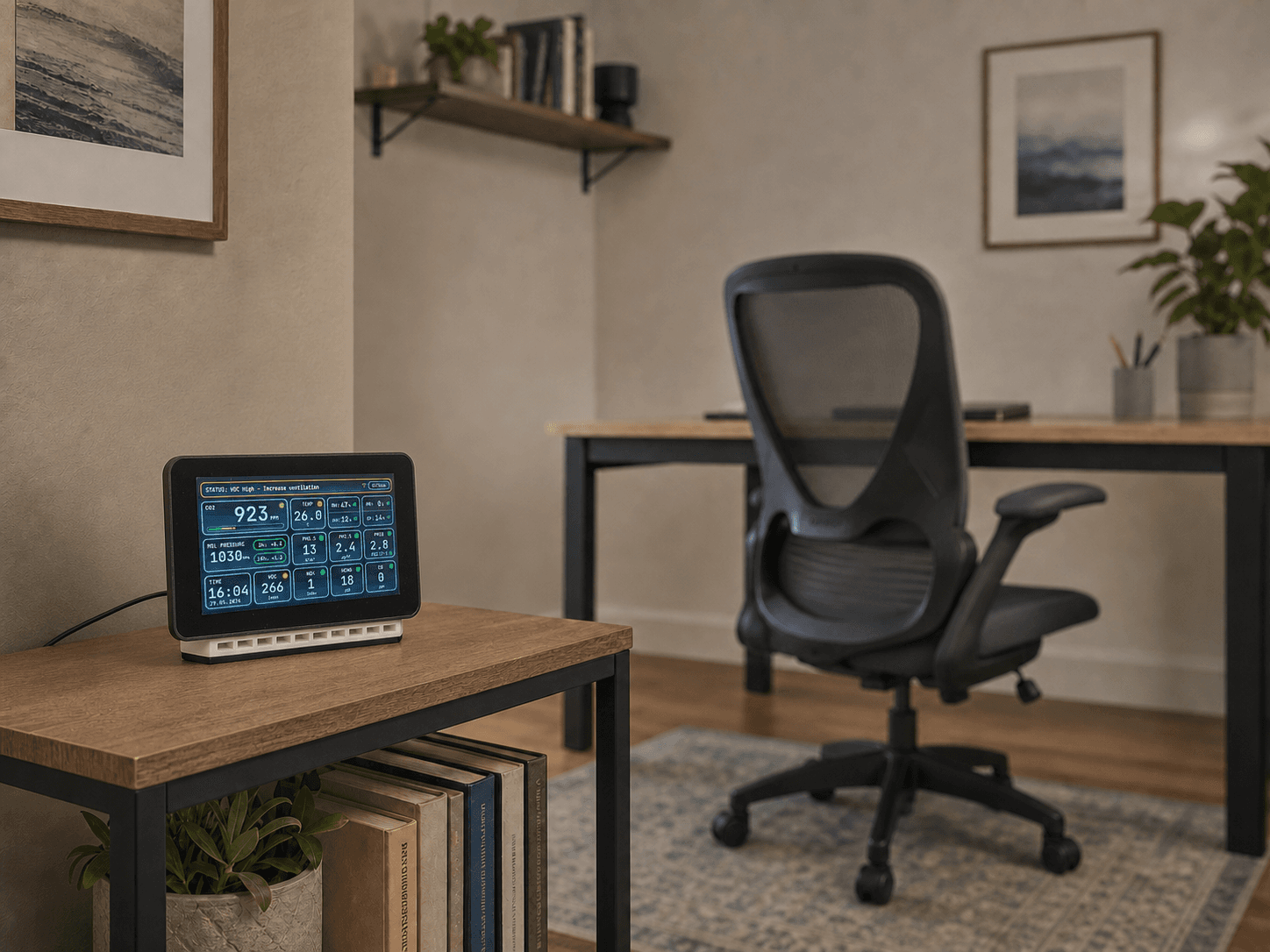
Put the monitor near the breathing zone, but more than 50 cm from a person. Keep it away from open windows, doors, supply vents, radiators, direct sun, and dead corners behind furniture. In a large room, one point may not represent the whole space.
Then leave it alone long enough to see a pattern. The UK HSE specifically warns that snapshots can mislead and recommends measurements across normal occupancy and ventilation conditions.
What Aura AQ is actually measuring
Aura AQ uses the Sensirion SEN66 multi-sensor platform for its standard CO₂ channel. Sensirion specifies a 0–40,000 ppm output range and publishes accuracy bands and calibration conditions in the SEN6x datasheet.
Two practical details matter more than displaying extra decimal places:
- give the device time to respond after moving it or changing the room;
- follow the calibration guidance, including periodic exposure to fresh-air conditions where required by the sensor’s automatic self-calibration routine.
No consumer monitor should be treated as a laboratory reference instrument. Its value is repeatable, continuous context: the same room, over time, while you change one variable.
The useful habit: compare the room with itself
Do not chase a perfect number all day. Learn the shape of your room:
- What happens with one person versus two?
- How quickly does the room climb with the door closed?
- Which ventilation change produces a clear response?
- Does solving CO₂ introduce outdoor particles?
- What happens overnight, not just during a two-minute check?
Once you know that baseline, CO₂ stops being a mysterious number and becomes a practical feedback loop.
Frequently asked questions
What is a good indoor CO₂ level?
There is no universal number that proves a room is safe or healthy. In an occupied room, lower values closer to the outdoor background generally indicate more outdoor-air ventilation. UK HSE guidance says levels consistently above 1,500 ppm indicate poor ventilation and should prompt action.
Is 1,000 ppm dangerous?
It is not a universal toxicity threshold. Around 1,000 ppm can be a useful ventilation reference under specific assumptions, but the trend, occupancy, room and applicable building guidance matter.
Will an air purifier lower CO₂?
Most will not. Particle filters recirculate air and remove particles; they do not provide the outdoor-air exchange needed to remove exhaled CO₂.
Will air conditioning lower CO₂?
Only if the system actually introduces outdoor air. A typical recirculating split unit can cool the room without materially lowering CO₂.
Why does bedroom CO₂ rise overnight?
People keep exhaling while closed doors and windows restrict air exchange. A small room with two occupants can therefore climb steadily for several hours.
Where should I put the monitor?
Near the occupied breathing zone, more than 50 centimetres from people, and away from windows, doors, supply vents, heat, direct sun and stagnant corners.
Does a CO₂ monitor detect carbon monoxide?
No. CO₂ and CO are different gases. Use certified CO alarms where required; never substitute a CO₂ monitor for one.
Sources and further reading
This guide prioritises primary and authoritative sources. Accessed 23 July 2026.
- UK HSE: Using CO₂ monitors
- ASHRAE: Position Documents, including Indoor Carbon Dioxide
- US EPA: Can indoor CO₂ provide information on ventilation?
- NOAA Global Monitoring Laboratory: Atmospheric CO₂ trends
- NIOSH Pocket Guide: Carbon dioxide
- Du et al. (2020): Effects of indoor CO₂ concentrations on human health and cognition: a critical review
- Sensirion: SEN66 product specifications and datasheet
Aura AQ is an environmental monitor, not a medical device or certified life-safety alarm. Use local building, workplace, and public-health requirements where they apply.