
Indoor humidity explained: why 50% RH is not the whole story
Learn what indoor relative humidity means, how heating and cold walls change it, when dampness matters, and how to read a home humidity sensor.
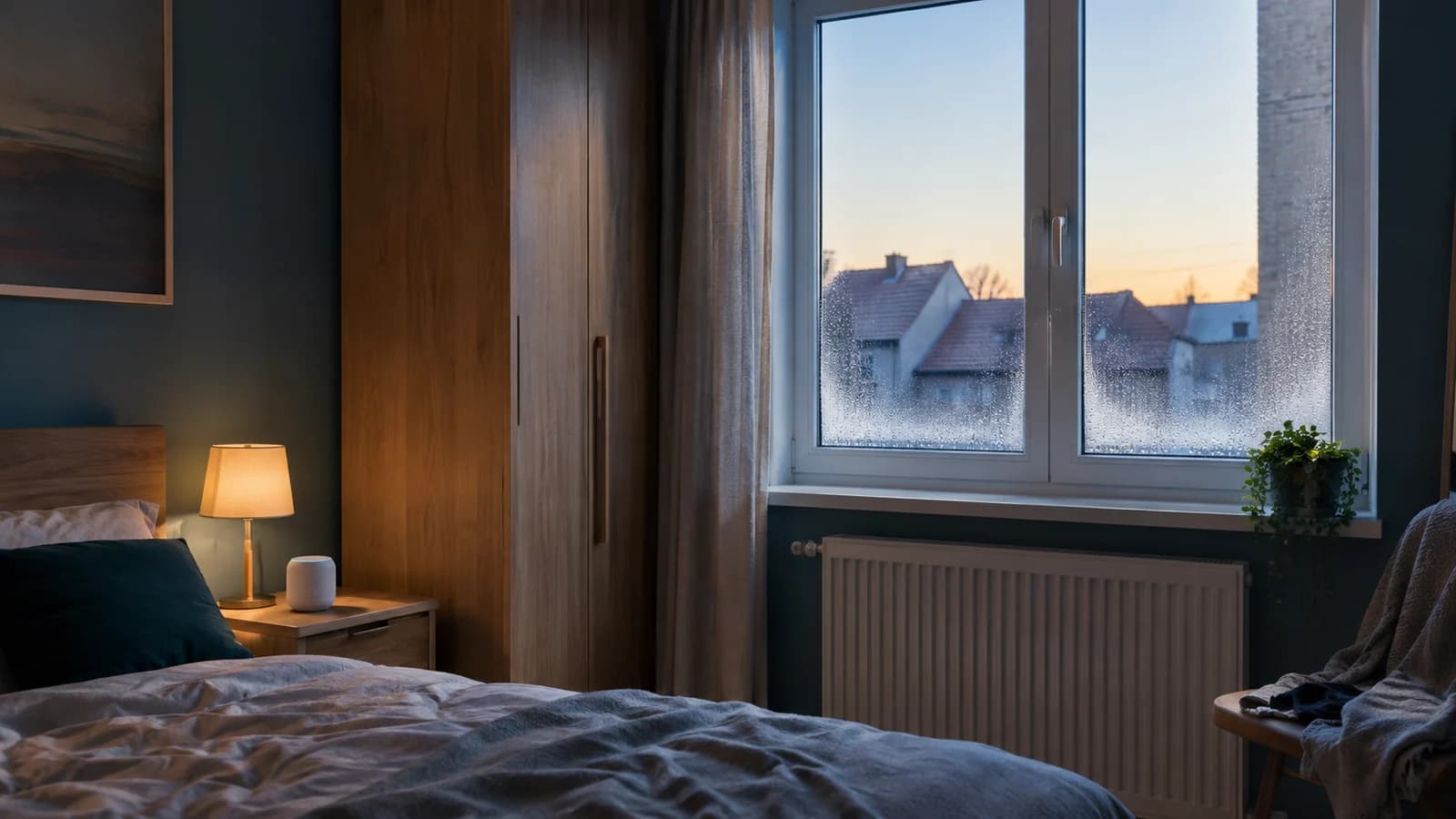
The bedroom monitor says 50% relative humidity. The middle of the room feels fine. Behind the wardrobe, the outside wall is cold enough to make a very different number.
That is the small mystery at the centre of indoor humidity. The percentage on the screen is real, useful and incomplete. It changes with temperature, while condensation and mould care about what happens on the coldest surfaces in the room.
Read relative humidity with temperature, time and surfaces.
Indoor relative humidity (RH) tells you how close the air is to saturation at its current temperature. It does not tell you the amount of water vapour on its own, whether a cold wall is wet, or whether the room is healthy.
| Reading | What it tells you | What it misses |
|---|---|---|
| Relative humidity | How close the air is to saturation at the measured temperature | The water content without temperature, and conditions on colder surfaces |
| Dew point | The temperature at which that air would become saturated | The actual temperature of every wall, window and hidden corner |
| Trend over time | Whether a moisture event is brief, repeating or persistent | The source unless you connect it with room activity |
The US EPA advises keeping indoor RH below 60%, ideally between 30% and 50% as practical moisture and mould-control guidance. That range is useful, but it is not a universal comfort certificate. A cold wall can be damp while the monitor still reports a respectable number.
What does relative humidity actually measure?
Relative humidity compares the water-vapour pressure already in the air with the saturation pressure at the same temperature. At 100% RH, the air is saturated. Cool it further and water can condense.
Temperature changes the size of the comparison. Warm air can reach a much higher saturation vapour pressure than cool air, so the same percentage can represent very different quantities of water.
The Met Office distinguishes RH from specific humidity and mixing ratio, which describe the amount of water vapour more directly. In a living room, RH remains convenient because sensors measure it easily and it responds to conditions that affect people and materials. It simply needs its temperature attached.
The same 50%, two different rooms
These are calculated examples using a standard psychrometric approximation:
| Air condition | Water vapour | Dew point |
|---|---|---|
| 18°C and 50% RH | 7.68 g/m³ | 7.4°C |
| 28°C and 50% RH | 13.60 g/m³ | 16.6°C |
Both monitors display 50%. The warmer cubic metre contains about 77% more water vapour. The percentage sign looks reassuringly decisive. The physics did not get that memo.
Absolute humidity in g/m³ is useful for comparing the moisture carried by two air masses. Dew point is often easier for practical decisions because it tells you how cold a surface must become before condensation starts.
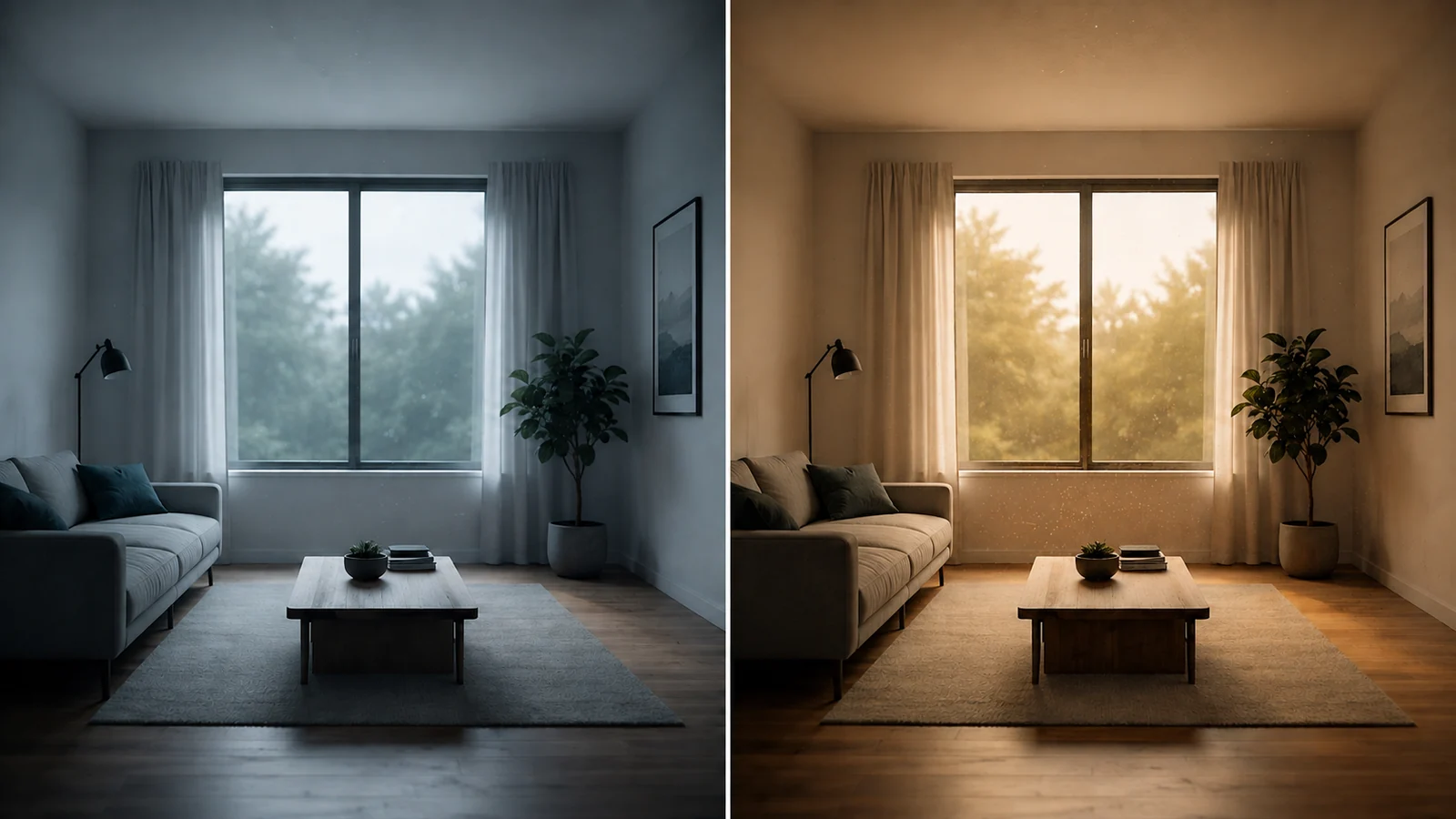
Does heating remove water from the air?
A normal radiator or electric heater does not remove water vapour. It warms the air, which raises the saturation vapour pressure and lowers RH if no water is added or removed.
Imagine outdoor air at 5°C and 80% RH. It contains about 5.44 g/m³ of water vapour and has a dew point near 1.8°C. Warm the same air to 20°C without adding moisture and its RH falls to about 30%.
The radiator changed the denominator, not the water inventory.
Real homes complicate the calculation. People breathe, cook and shower. Fabrics and plaster absorb and release moisture. Ventilation replaces indoor air with outdoor air. Even so, a quick RH drop when heating starts often reflects temperature first, not sudden dehumidification.
If temperature rises while RH falls in a matching curve, heating is the likely explanation. If RH falls while temperature stays stable, ventilation or active dehumidification becomes more plausible.
Dew point explains the wet window
Dew point is the temperature at which air becomes saturated and water vapour begins to condense. It connects the room reading with the building.
Take a room at 20°C and 50% RH:
- the room contains about 8.64 g/m³ of water vapour;
- its dew point is about 9.3°C;
- a wall surface at 12°C sees local RH of roughly 83%;
- a surface at 9.3°C is at the point where condensation can begin.
The monitor in the room can still show 50%. It measures the air around the monitor, not the window spacer, an uninsulated reveal or the patch of wall behind a tightly packed wardrobe.
A room can have ordinary RH and still collect water on one cold surface. A brief room-wide RH spike can leave no damage when warm surfaces dry quickly.
Room RH is evidence about the air. It is not a moisture meter for the building fabric, a leak detector or a mould detector.
Is 40–60% RH the ideal range?
Use ranges as working guidance, not as traffic lights handed down by physics.
ASHRAE Standard 55 treats thermal comfort as a combination of air temperature, thermal radiation, humidity, air speed, clothing and activity. A person sitting beside a cold window can feel uncomfortable while the thermostat and hygrometer look ordinary.
An addendum to Standard 55-2020 states that the standard does not set a maximum or minimum humidity for thermal comfort. It also notes that very low humidity can create non-thermal problems such as dry eyes, irritated mucous membranes and static electricity.
A practical home interpretation looks like this:
| Pattern | A sensible interpretation |
|---|---|
| Persistent RH below 30% at normal room temperature | Check whether the room is overheated, ventilation is excessive, and people have dryness symptoms before adding moisture |
| RH around 30–50% | EPA's ideal moisture-control range for many homes, still subject to surface temperature and personal comfort |
| RH around 50–60% | Not automatically dangerous; watch duration, condensation and cold rooms |
| Persistent RH above 60% | Look for moisture sources, weak extraction, cool surfaces, leaks or seasonal outdoor moisture |
Low humidity can contribute to eye irritation, especially during screen work where blinking often falls. A review of office-eye research supports that mechanism. The intervention evidence is less tidy: a 2021 Cochrane review found low or very-low certainty evidence for several benefits of workplace humidification and no eligible studies reporting upper respiratory infection outcomes.
A humidifier may improve comfort in a genuinely dry room. It cannot promise fewer colds, and it should not be used to chase a green icon while the windows are already wet.
At what humidity does mould grow?
Mould needs moisture on a surface. The room's RH influences that moisture, but temperature, material, air movement and duration decide what the surface experiences.
The WHO dampness and mould guidelines associate persistent dampness and microbial growth with more respiratory symptoms, allergies and asthma. WHO's practical priority is preventing or minimising persistent dampness and microbial growth in surfaces and structures.
A single 65% reading after a shower does not diagnose a mould problem. A cold corner that stays damp, a recurring musty smell, water damage or visible growth deserves attention even when the room average later returns to 50%.
If you find mould, fix the water source as well as cleaning the visible growth. EPA notes that mould is likely to return when cleanup leaves the moisture problem in place.
Watch for:
- condensation that returns on the same window, wall or pipe;
- RH that stays above 60% for long periods rather than minutes;
- a room that remains cooler and more humid than the rest of the home;
- wet materials after a leak;
- visible growth, staining or a persistent musty smell.
A room monitor can show conditions that support a dampness investigation. It cannot tell whether the source is a plumbing leak, rain penetration, rising damp, weak ventilation or a cold bridge.
Can 90% outdoor humidity dry a home?
Yes, in cold weather. Outdoor RH can look high because cold air reaches saturation with little water vapour.
Compare dew point or absolute humidity:
| Situation | What opening the window tends to do |
|---|---|
| Cold outdoor air with a lower dew point than indoors | Replaces moist indoor air with drier air; after reheating, indoor RH falls |
| Warm, humid outdoor air with a higher dew point than indoors | Adds moisture; a cool basement or air-conditioned room can become damper |
| Outdoor dew point close to indoor dew point | Provides little drying; ventilation may still be needed for CO₂ and pollutants |
If RH and indoor CO₂ rise together overnight, people are adding both water vapour and exhaled air faster than the room removes them. The pattern supports a ventilation hypothesis. It does not reveal the exact airflow rate.
In England, Approved Document F requires extract ventilation to outside in kitchens and bathrooms for relevant building work. In an existing home, the practical principle is the same: capture steam near the shower or hob instead of asking the entire house to deal with it later.
Which appliances change humidity?
| Appliance or action | What happens to moisture |
|---|---|
| Radiator or electric heater | Warms air; RH usually falls, water vapour is not directly removed |
| Air conditioner in cooling mode | Can condense and drain water when the coil is below dew point |
| Dehumidifier | Removes water into a tank or drain; usually warms the room slightly |
| Outdoor-vented extractor | Removes moist indoor air and replaces it with make-up air |
| Recirculating HEPA purifier | Removes particles, not water vapour |
| Room fan | Moves air and can help surfaces or skin dry, but does not remove water from a closed room |
| Humidifier | Adds water; the method and water quality matter |
Why can an ultrasonic humidifier raise PM2.5?
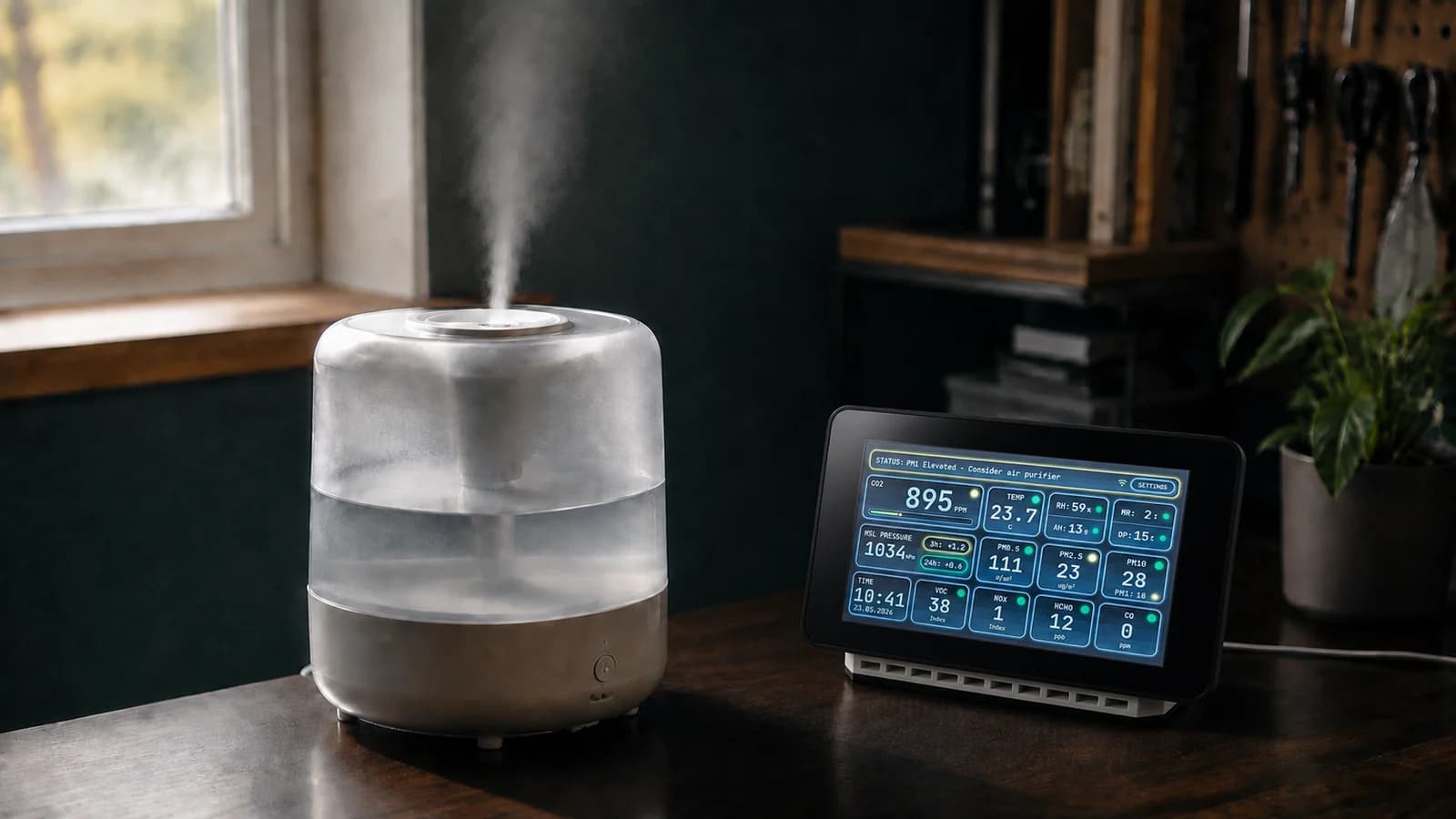
An ultrasonic humidifier turns liquid water into small airborne droplets. When tap water contains dissolved minerals, the water can evaporate and leave mineral particles behind.
The EPA recommends distilled water or suitable demineralisation to reduce minerals and white dust, alongside regular cleaning and the manufacturer's instructions. EPA also advises against using a humidifier to push indoor RH above 50%. If condensation appears, reduce the output or use.
A 2021 whole-house experiment found that one ultrasonic humidifier could raise measured PM2.5 into the hundreds of micrograms per cubic metre, with results depending on the fill water, airflow and ventilation. That does not mean every humidifier produces the same number. It does explain why a particle monitor may jump when the mist starts.
The monitor is not being dramatic. The humidifier may be launching very small mineral leftovers.
How accurate is a room humidity sensor?
Every humidity sensor has tolerances. The Sensirion SEN6x datasheet specifies typical RH accuracy of ±4.5 percentage points at 25°C between 30% and 70% RH. It specifies typical temperature accuracy of ±0.45°C under its stated test conditions.
Two monitors side by side can therefore disagree by several RH points without either one being broken. A small temperature difference between their enclosures can widen the visible gap because RH itself depends on temperature.
Placement can matter more than the last digit:
- keep the monitor in open room air;
- avoid direct sun, radiators, windows and supply vents;
- do not place it in the humidifier plume;
- keep it away from the breath jet beside a pillow;
- leave it in one representative position when comparing day-to-day trends.
The complete monitor placement guide explains representative monitoring and short local source tests. A stable trend from a sensible position is usually more useful than moving the monitor around to find the number you hoped for.
A practical way to investigate humidity
- Read temperature and RH together. A change in either affects the meaning of the other.
- Look at duration. A shower peak that clears is different from a damp room that never recovers.
- Match the timing to a source. Cooking, bathing, drying laundry, sleeping and opening windows leave recognisable patterns.
- Inspect the cold surfaces. Check windows, outside corners, areas behind furniture and cold pipes for recurring condensation or staining.
- Use extraction at the source. Run an outdoor-vented kitchen or bathroom extractor and give the room time to recover.
- Compare indoor and outdoor dew point. Ventilation dries when the incoming air carries less moisture; warm humid weather can reverse the result.
- Choose equipment for the mechanism. Use a dehumidifier when ventilation cannot remove moisture, or cautious humidification when the room stays genuinely dry at a reasonable temperature.
- Change one variable and watch the trend. The response tells you more than a single peak.
Investigate leaks, persistent dampness and visible mould as building problems, not merely sensor problems. Seek medical advice for persistent breathing, eye or skin symptoms. A humidity graph can support the conversation, but it cannot diagnose the person or the building.
Frequently asked questions
Is 60% indoor humidity dangerous?
One 60% reading is not an emergency. EPA recommends staying below 60% for moisture control, so a persistent value above it deserves investigation. Duration, cold surfaces, condensation and water damage matter more than a brief peak.
Why does humidity fall when the heating turns on?
Heating raises the saturation vapour pressure. If the amount of water vapour stays similar, RH falls. The heater has changed the temperature rather than removed the water.
Why can opening a window in winter dry the room when it is raining?
Cold outdoor air can have high RH and still contain less water than warm indoor air. If its dew point is lower, warming that incoming air produces a lower indoor RH.
What is a good bedroom humidity?
EPA's 30–50% range is a useful moisture-control starting point. Personal comfort, outdoor temperature and the coldest bedroom surfaces still matter. Watch the overnight trend and CO₂ rather than judging one reading in isolation.
Can a dehumidifier replace ventilation?
No. A dehumidifier removes water while recirculating room air. It does not remove exhaled CO₂ or many indoor pollutants and does not supply outdoor air.
Can a humidity monitor detect mould or a hidden leak?
No. It can reveal a damp pattern or a room that does not recover, but it does not detect spores, measure wall moisture or identify the water source.
Why do two humidity monitors disagree?
Sensor tolerance, response time, enclosure temperature and airflow can all create a difference. Compare them after they have stabilised side by side, away from sun, heat and direct drafts.
Can a humidifier make PM2.5 readings rise?
Yes. Ultrasonic units can disperse minerals from tap water as fine airborne particles. Use distilled water when the manufacturer permits it, clean the unit as directed and keep the mist away from the monitor.
The useful habit: read the room, not the colour
A humidity tile compresses temperature, moisture, surfaces and time into one percentage. Use it as the start of the investigation.
When the number changes, ask what changed with it. When the number looks normal, check whether the window or cold wall agrees. The trend can help you test ventilation, heating, extraction and equipment without pretending that one sensor can see through plaster.
Explore the other Aura Blog guides for particles, gas indices and ventilation.
Sources and further reading
This guide prioritises official guidance, current manufacturer documentation and peer-reviewed reviews. Calculated examples use the Magnus-Tetens approximation and are illustrative, not measured Aura AQ datasets. Sources were accessed on 3 September 2026.
- Met Office: Understanding humidity
- Met Office: Dew
- US EPA: A Brief Guide to Mold, Moisture and Your Home
- WHO: Guidelines for Indoor Air Quality, Dampness and Mould
- ASHRAE: Standard 55
- ASHRAE: Addendum h to Standard 55-2020
- Sensirion: SEN6x datasheet
- US EPA: Use and Care of Home Humidifiers
- Lau et al. 2021: Particulate matter emitted from ultrasonic humidifiers
- Cochrane review: Humidification of indoor air
- Wolkoff et al.: The modern office environment desiccates the eyes?
- GOV.UK: Approved Document F
Educational information only. Aura AQ is an environmental monitor, not a medical device, building survey, moisture meter or mould detector. Follow local building, public-health and medical guidance where it applies.