
First, I want to apologise to anyone who bought an additional DFRobot gas sensor for Project Aura AQ and was disappointed to discover afterwards that it did not suit their intended use. I share the responsibility for that: I should have explained what these sensors are useful for and helped you choose.
I added support for these sensors after people asked me to include them for Project Aura AQ devices used in specific working conditions. I thought these capabilities might interest other users too, so I included support in the public version. I expected people who needed these measurements to look into the sensors' characteristics themselves. I now realise that I should have explained from the start how they work, which tasks they suit and what to consider when choosing one.
On a poultry farm, the owner needs to know whether ammonia is building up. In a workshop, it is useful to see how readings change while engines are running. At a site that treats water with ozone, operators need to monitor ozone in the air around the equipment. That is why Project Aura AQ supports several additional gas modules: you can build the device for a particular task.
Project Aura AQ is used both at home and in industry. Some applications have already been tested in real workplaces, but I cannot share the details of those projects. To explain what the sensors can do, I have chosen general practical examples for this article. There are many more possible uses.
An additional sensor is useful when you know which gas you want to monitor and what you want to learn from its readings. At home, that measurement might be CO. The other sensors are more often useful for a particular job or type of room; there is no need to buy the whole set for an ordinary flat.
The AI-generated illustrations are playful, fictional scenes, including the invented reading on the television.
Which sensors can you connect?
This article covers seven DFRobot Gravity sensors: carbon monoxide, ammonia, hydrogen sulphide, sulphur dioxide, nitrogen dioxide, ozone and oxygen. Each module is intended for its particular gas. These are called electrochemical sensors: the gas causes a reaction in the sensing element, and the electronics turn it into a reading on the screen. DFRobot gas sensor family
You can fit Project Aura AQ with a CO sensor or one sensor for a gas chosen from the other six. For example, you might choose ammonia for a farm.
I am keeping support for this range: readily available modules and simple connections matter when you build a device yourself. Project Aura AQ can receive and display their data. When choosing a sensor, you still need to check that it is accurate enough for your task and suitable for the place where you will install it.
This article applies specifically to the SEN04xx models listed here. DFRobot also offers other sensor families with different specifications, including formaldehyde sensors. Findings about one range should not be applied to the whole catalogue.
You will see the unit ppm, meaning "parts per million". For example, 10 ppm means roughly 10 molecules of the gas being measured for every million molecules in the gas mixture. For the same gas, a higher number means more of it in the air. But the same number for different gases does not mean the same effect on a person.
CO at home: fireplaces, stoves and fuel-burning heaters
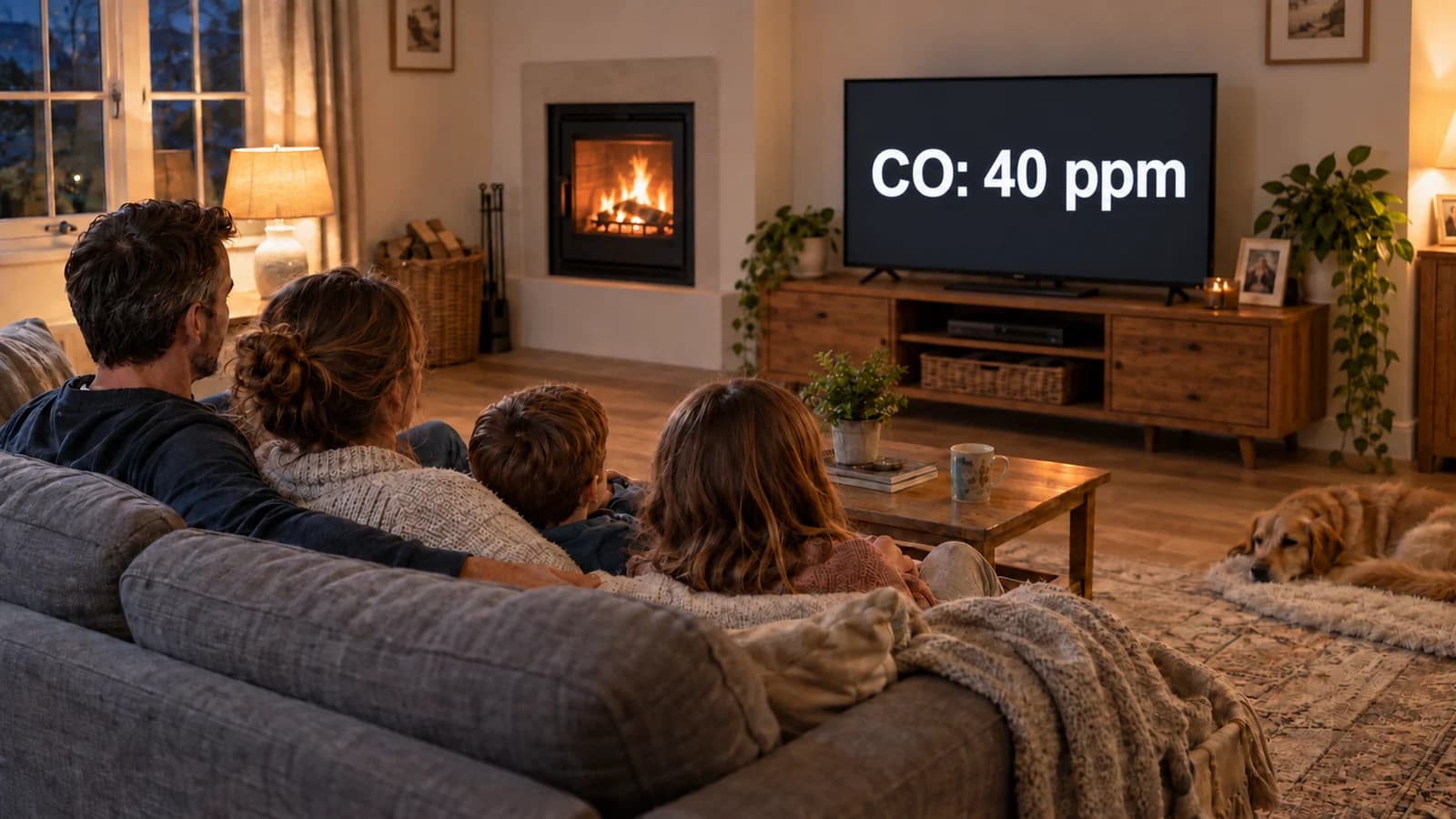
You are spending an evening with your family by the fireplace. The room is warm, and you want to know what is happening to the air as the fire burns. An additional CO sensor lets you follow the carbon monoxide readings: do they stay at roughly the same level, or start to rise while the fire is burning? Home heating is one of many uses for a CO sensor.
The same question matters in a home with a wood-burning stove, gas boiler, or gas or kerosene heater. Incomplete fuel combustion produces CO, and problems with the draught or chimney can allow combustion gases to enter the room. Carbon monoxide itself has no colour or smell, so you cannot sense its presence. EPA on sources of CO in the home
The value of a CO sensor in Project Aura AQ is that you can see numerical readings and how they change over time. You can notice a rise while the heating is in use, see whether it continues and check when it began. The sensor can also show high CO readings, helping you notice a dangerous build-up of the gas. The SEN0466 has a measurement range of 0 to 1000 ppm. DFRobot specifications
In my home, it shows changes even when I turn on the gas cooker: the readings rise from 0 to about 10 ppm. This is my own observation at home, and it illustrates why I find an additional CO measurement useful. The device lets me see how the readings relate to what is happening in the room.
You need a certified CO alarm to sound a loud warning, including at night when the family is asleep. Its response depends on the gas concentration and the duration of exposure: it is not required to sound at every small change. The FireAngel manual gives an example of these rules. Project Aura AQ adds readings and a history alongside that protection, but does not replace a separate alarm: DFRobot does not permit the module to be used for life safety. Manufacturer's restriction
Do not ignore high CO readings, even if the alarm has not sounded. If you suspect a build-up of carbon monoxide, get into fresh air and contact the emergency services; if you feel unwell, seek urgent medical help. NHS guidance
Practical uses for the other gases
Measurements of these gases can be useful beyond an ordinary flat. The following examples explain why someone might need them. When choosing a sensor, check how much gas you expect in the air, which changes you need to notice and the conditions in which it will operate. Assessing workplace safety and protecting people require instruments designed for those purposes.
NH₃: poultry farms, stables and industry
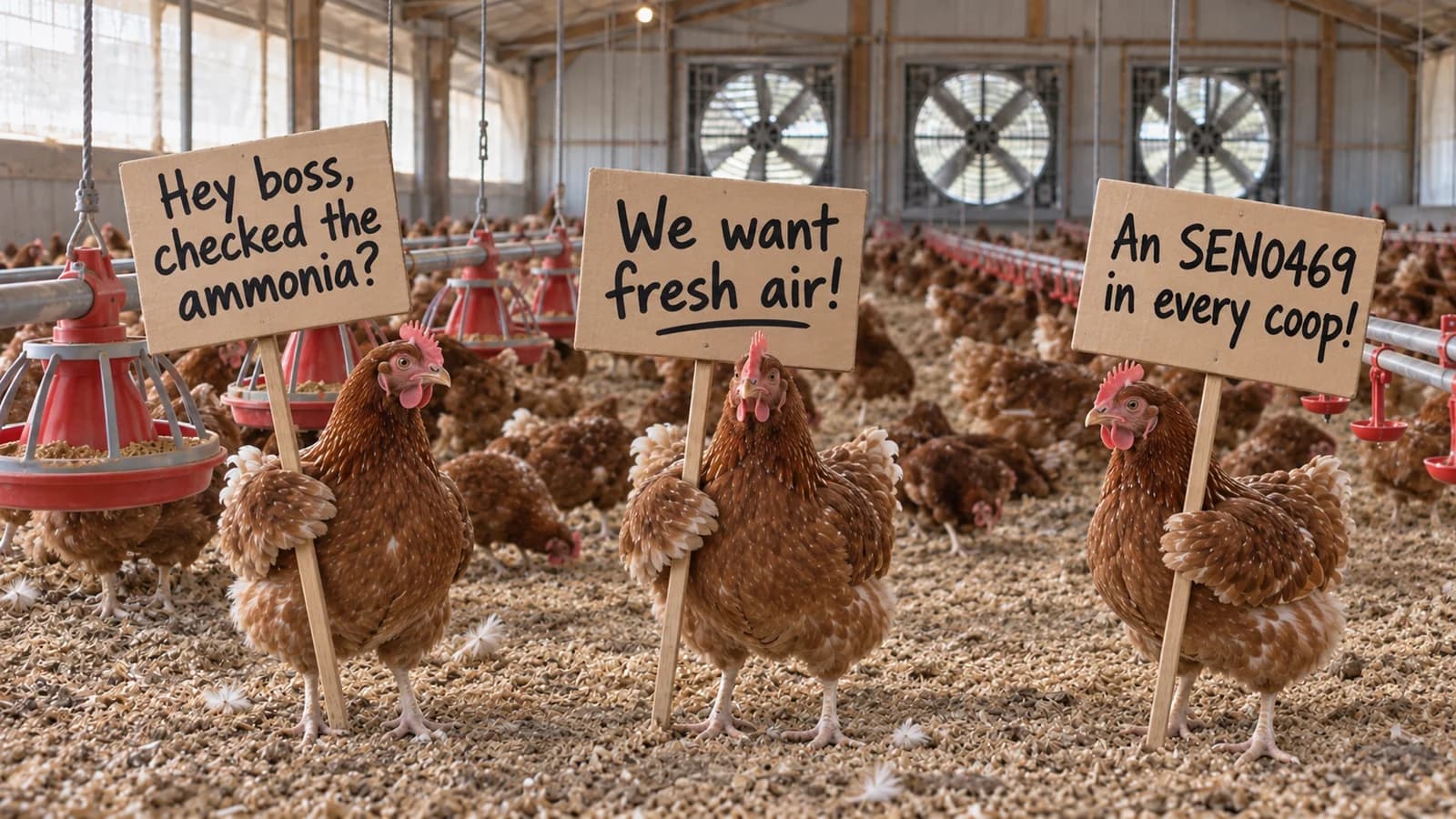
A poultry farm is one of many places where measuring ammonia, NH₃, is useful. It forms as poultry droppings break down in the bedding on the floor. University of Kentucky on the source of ammonia
Wet bedding produces more ammonia, while ventilation helps remove it from the air. It is therefore useful for the owner to see how readings change after cleaning, drying the bedding or adjusting the ventilation. UGA on bedding and ammonia
The University of Georgia describes a possible situation: with ventilation running during the day, concentrations are 10–15 ppm, but they can rise to 40–60 ppm after airflow is reduced at night. A daytime inspection can miss what happened overnight. This is an example of conditions on a farm, not a Project Aura AQ test result. UGA on variations through the day and night
A history of readings helps reveal these overnight rises and whether they recur after changes on the farm. For example, after drying the bedding, you can compare several nights with similar operating conditions: are the rises smaller, and how long do readings remain elevated? The owner can then see whether anything has changed during the hours when nobody makes an inspection.
Ammonia is also measured in other settings:
- Stables. Ammonia is released as urine in the bedding breaks down. Removing wet bedding reduces the source of the gas, while ventilation helps carry it out of the building. Purdue University on ammonia in stables, Penn State on stable ventilation
- Industrial refrigeration systems. Some dairies, ice cream factories and cold stores use ammonia as a refrigerant, meaning a substance used to provide cooling. NH₃ is measured in the air around the equipment. OSHA on ammonia refrigeration systems
- Organic waste processing. Composting materials rich in nitrogen, such as grass clippings, can release ammonia. Readings can be compared for different batches of material. Cornell University on ammonia in composting
- Storing and transferring ammonia for fertilisers. NH₃ is measured in the air around tanks and pipework during transfers and maintenance. EPA on ammonia fertiliser storage sites
The SEN0469 can be considered for additional monitoring after checking the expected concentrations, its readings and the installation conditions. On a farm, protection from dust and moisture also needs planning. One sensor measures the air where it is installed; different areas of a large poultry house or stable may need separate monitoring.
In industrial installations, protective alarms and automatic safety systems do their job independently of the additional readings from Project Aura AQ.
CO and NO₂: engines, forklifts and exhaust extraction
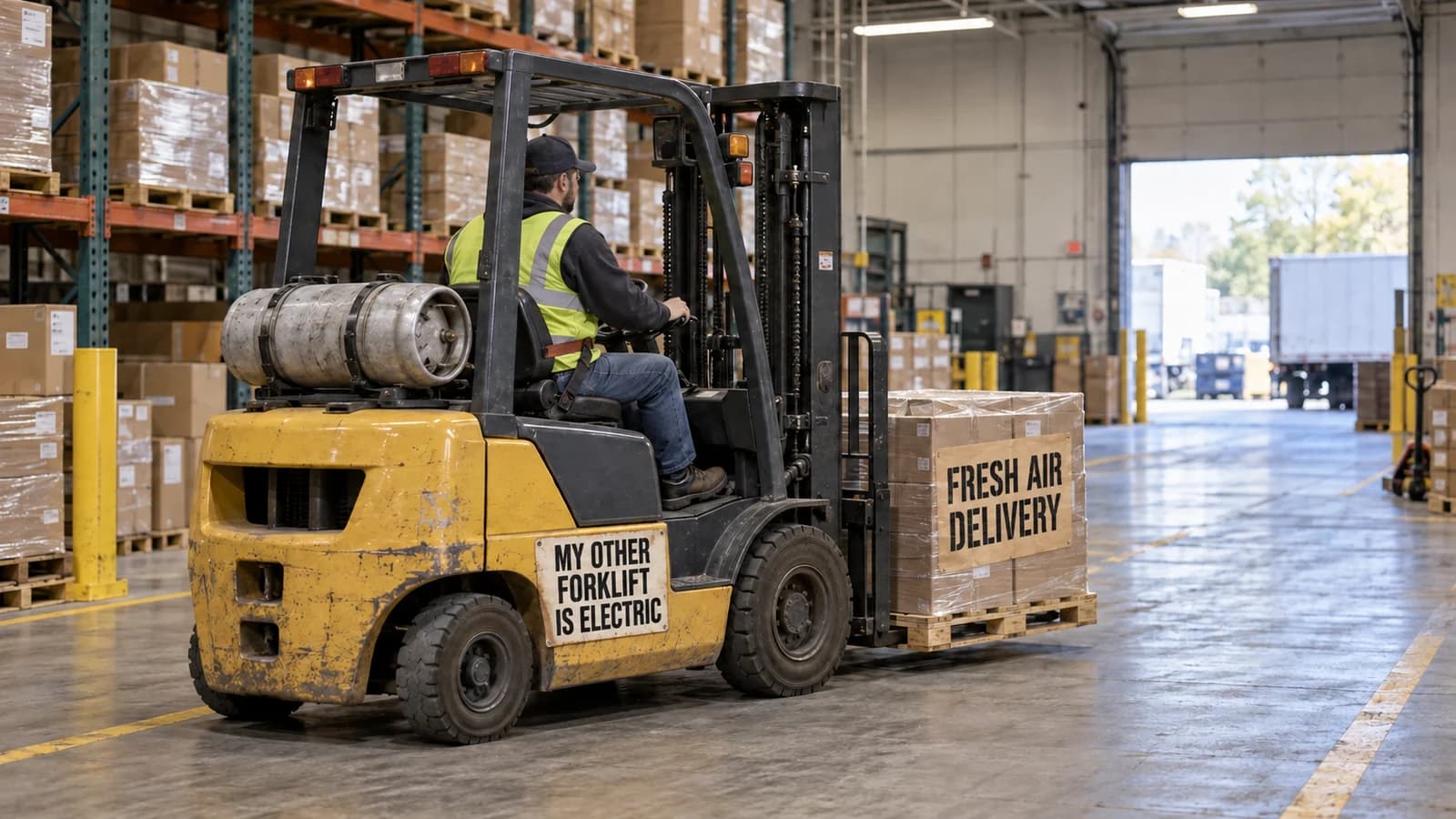
Monitoring exhaust gases is one of many uses for CO and NO₂ measurements. In a vehicle workshop or warehouse, car engines and fuel-powered forklifts may run indoors. Additional measurements help reveal when readings rise and how long they stay elevated after the equipment stops.
HSE lists CO and nitrogen oxides among the components of exhaust gases; the mixture depends on the engine and how it is running. CDC also documents CO accumulating when gas-powered forklifts operate indoors. NO₂, or nitrogen dioxide, provides a separate measurement, but even together with CO it does not describe the full exhaust mixture. HSE on exhaust gases, CDC on forklifts
Suppose the readings rise repeatedly while one forklift is running, then take a long time to return to their previous level after it stops. Comparing the history with the equipment's operating times can help you decide to check the extraction in that area. After maintenance, it is useful to compare similar shifts: are the rises smaller, and do readings fall more quickly? Account for how long the equipment ran, whether the doors were open and how the ventilation was operating.
Ventilation adequacy and workplace safety must be assessed with equipment designed for those purposes.
H₂S: biogas, farms and industrial processes
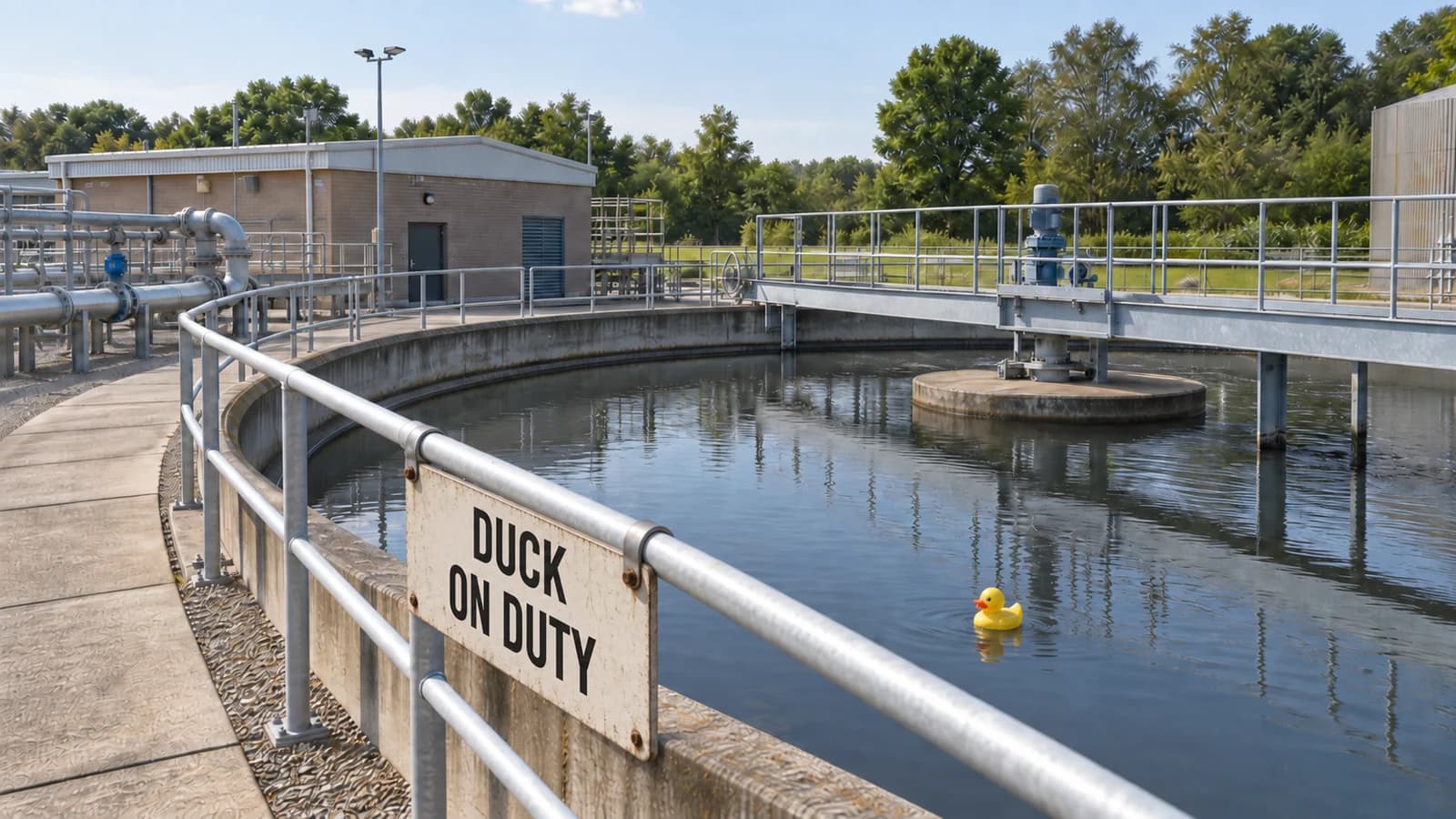
The treatment works in the illustration show one of many places where measuring hydrogen sulphide, H₂S, is useful. These measurements are also needed elsewhere:
- Biogas plants. Manure and food waste are used to produce gas for energy generation, and that gas can contain H₂S. Here, monitoring concerns H₂S in the air around the equipment, outside the pipework. EPA on biogas systems
- Livestock farms. Hydrogen sulphide forms when liquid manure breaks down without oxygen. Much more can be released during stirring and pumping. University of Minnesota
- Pulp and paper production. H₂S can arise in production processes. OSHA on H₂S in industry
- Geothermal sites and hot springs. Hydrogen sulphide can be released naturally. Measurements help track its build-up inside buildings that use thermal water. WorkSafe on natural sources of H₂S
In these projects, it is useful to compare the reading history with equipment and ventilation operation: when do rises begin, how long do they last, and do they recur after maintenance? This helps show changes across the whole shift, including the hours when nobody makes an inspection.
The SEN0467 can be considered for additional air monitoring. Check the expected concentrations, the sensitivity you need and the installation conditions, including dust and moisture. Monitoring a faint smell may require a more sensitive instrument. Analysing the biogas itself inside a pipe, or working in potentially explosive atmospheres, requires specialist equipment.
O₃: swimming pools, laundries and food production

A swimming pool with ozone water treatment is one of many applications for ozone, O₃. The gas is used for disinfection and odour removal. Measuring ozone in the air around equipment can be useful in a range of settings:
- Beverage production and container washing. Ozonated water is used to treat bottles, vessels and pipework. O₃ is measured in the air beside the washing line. Xylem on food production
- Industrial laundries. Some systems add ozone to the water to wash and disinfect laundry. Readings are compared during washing and rinsing. Ozone systems in laundries
- Swimming pools with ozone water treatment. Air can be monitored in the plant room containing the generator and ozone delivery equipment. Ozonetech applications
- Odour removal from extracted air. In professional kitchens, for example, ozone is fed into the extraction duct to treat odours and grease contamination. Ozone is measured in the room air around the equipment. Ozonetech on kitchen exhaust treatment
In these projects, you can compare the reading history with the ozone generator's operating mode and the ventilation. If rises recur at the same stage, that is a reason to check the relevant equipment and gas extraction. After maintenance, you can see whether the same pattern returns under the same operating conditions.
In all these examples, the sensor monitors ozone in the air. Measuring dissolved ozone and assessing water treatment require different instruments. Xylem measuring instruments
The SEN0472 can be considered for additional monitoring if it suits the expected concentrations, required sensitivity and operating conditions. It must not determine when people may re-enter a room after treatment with an ozone generator. The process's monitoring and protective systems operate independently of Project Aura AQ.
SO₂: wineries, dried fruit and industry

A winery is one of many places where measuring sulphur dioxide, SO₂, is useful. Winemakers use it to protect wine from unwanted changes caused by contact with oxygen and from microorganisms that can spoil it. Some dissolved SO₂ can pass from the wine into the air. Iowa State University on SO₂ in wine
On a bottling line, for example, an operator may want to know whether readings rise while the line runs and how long they remain elevated. The history can be compared with the bottling schedule and extraction operation. If rises recur at the same stage, this helps identify an area to check. After maintenance, it is useful to compare similar operating cycles and see whether the pattern has changed. SafeWork NSW winery guide, page 19
These measurements are also useful in other settings:
- Dried fruit production, such as dried apricots. Apricots may be treated with SO₂ before drying to slow browning and preserve their colour. The gas can enter the surrounding air during this process. EPA on dried fruit production
- Pulp and paper production. Some processes treat wood with SO₂-based solutions to separate the fibres. EPA on wood processing
- Industrial boilers burning coal or heavy fuel oil. Burning fuel that contains sulphur produces SO₂. The air around the boiler can be monitored during start-up and changes in load. EPA on sources of SO₂
The SEN0470 can be considered for additional air monitoring after checking the expected concentrations and installation conditions. Comparing its readings with a more accurate instrument is particularly important when choosing it: a published study found limitations in this module. Details are in the reference section at the end.
SO₂ in wine or dried fruit is measured by separately analysing the product. Measurements directly inside a flue also require equipment designed for that purpose.
O₂: crop storage and working with industrial gases
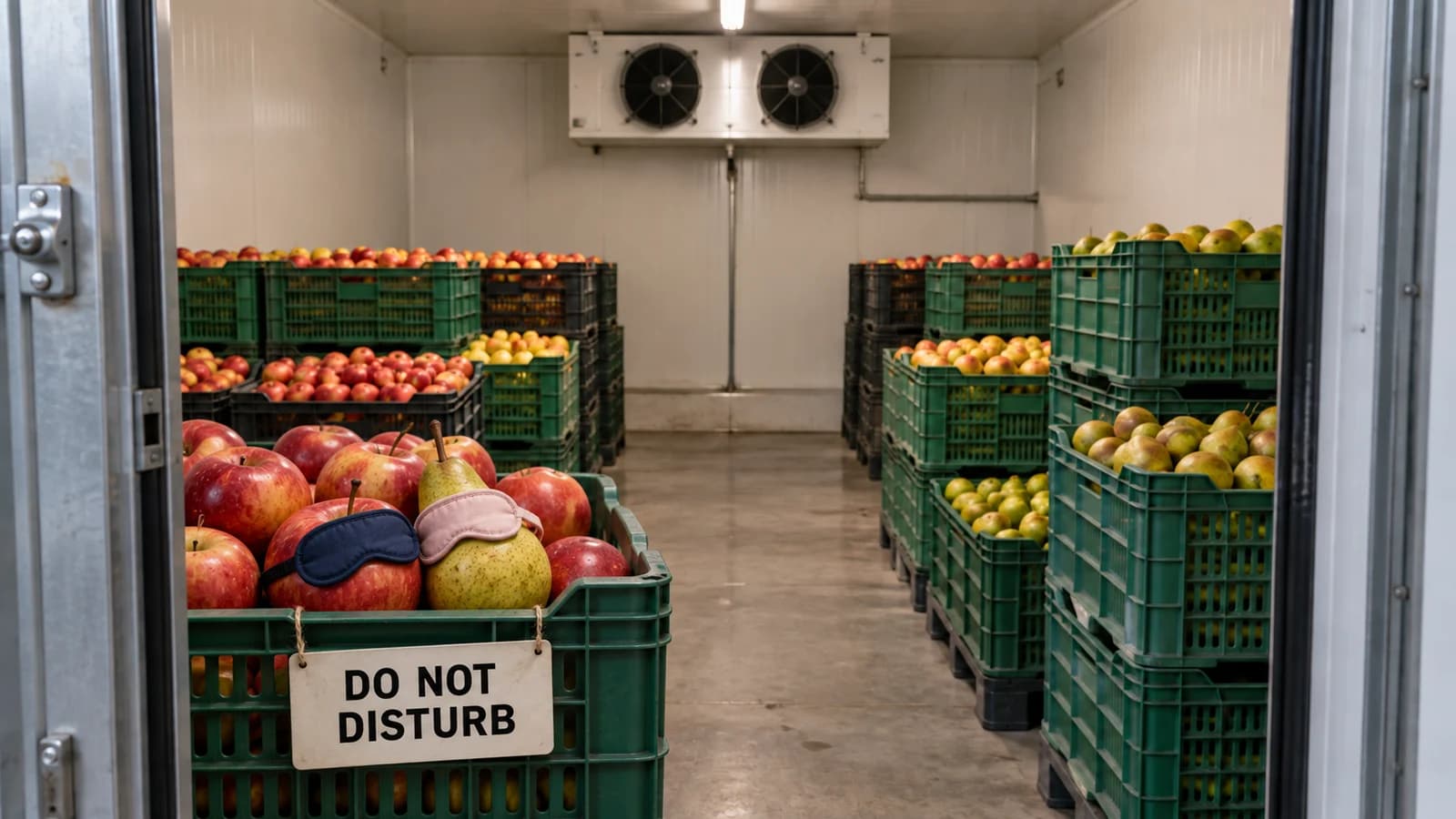
Fruit storage is one of many uses for oxygen, O₂, measurements. Even after harvesting, apples and pears continue to breathe: they take in oxygen and release carbon dioxide. To keep the crop for longer, specially sealed storage rooms maintain the required temperature and a different air composition. The oxygen proportion is reduced to slow the fruit's respiration and ripening. This is called controlled atmosphere storage. University of Maine on storing apples and pears
Here, an O₂ measurement answers a straightforward question: what is happening to the air inside the store? For example, you can observe oxygen falling as the room is prepared for storage, then rising again when ordinary air enters. A history of readings helps relate these changes to equipment operation.
Other examples where measuring oxygen is useful:
- Airtight storage of grain and pulses. Low oxygen levels in a sealed store help suppress insect pests. The oxygen proportion is measured in gas from inside the store. A sensor beside a closed container measures the room air, not the gas inside the container. Purdue University research
- Freezing food with liquid nitrogen. Nitrogen is used for rapid cooling. As it evaporates, it becomes a gas and, if it builds up in the room, reduces the proportion of oxygen in the air. Air Products on freezing with liquid nitrogen
- Welding areas using argon. Argon shields the weld from contact with air. If this gas accumulates in an enclosed space, it displaces air and the oxygen level falls. HSE on welding gases
The SEN0465 can be considered for additional monitoring of noticeable changes in the oxygen proportion, after checking its readings and installation conditions.
The storage room's own gas analysers and controls maintain the precise conditions needed for fruit: the right level depends on the variety, and reducing oxygen too far can damage the crop. University of Maryland on controlling the storage atmosphere
When monitoring a storage atmosphere, plan how to deliver the gas to the sensor and protect it from condensation. Separate instruments designed for the purpose are needed to warn of a dangerous lack of oxygen and to check the air before people enter. Project Aura AQ adds readings and a history alongside them.
Range, resolution and accuracy: what is the difference?
These modules measure small amounts of gas in ppm, and oxygen as a percentage of the gas mixture's volume. When choosing one, it helps to understand which concentrations it is designed to measure and how accurate its readings are.
Four specifications tell you different things:
- Range: the lowest and highest gas concentrations the sensor is designed to measure. For example, 0 to 1000 ppm.
- Resolution: the smallest step it can display. For example, 1 ppm or 0.1 ppm.
- Accuracy: how far a reading may differ from the amount of gas actually present in the air.
- Repeatability: whether you get similar readings when you repeat the measurement under the same conditions.
For this range, DFRobot asks you to calculate two values: 10% of the reading and 5% of the upper end of the range. The allowed deviation is whichever is larger, in either direction. The manufacturer calls the upper end of the range "full scale". DFRobot specifications
For example, a CO sensor displays 10 ppm. Ten per cent of that reading is 1 ppm, while five per cent of the upper limit of 1000 ppm is 50 ppm. The formula gives an allowed deviation of ±50 ppm.
This does not mean the CO module only begins to detect gas at 50 ppm, or that it is wrong by exactly 50 ppm every time. Nor does the tolerance mean that readings fluctuate randomly across that whole interval. An individual sensor may repeatedly show smaller changes too.
The table lists the specifications for all seven modules. The last column gives the calculated 5% of full scale. This is one part of the error calculation, not the smallest amount of gas the sensor can detect.
| Gas and module | Range | Resolution | 5% of full scale |
|---|---|---|---|
| CO · SEN0466 | 0–1000 ppm | 1 ppm | 50 ppm |
| NH₃ · SEN0469 | 0–100 ppm | 1 ppm | 5 ppm |
| H₂S · SEN0467 | 0–100 ppm | 1 ppm | 5 ppm |
| SO₂ · SEN0470 | 0–20 ppm | 0.1 ppm | 1 ppm |
| NO₂ · SEN0471 | 0–20 ppm | 0.1 ppm | 1 ppm |
| O₃ · SEN0472 | 0–10 ppm | 0.1 ppm | 0.5 ppm |
| O₂ · SEN0465 | 0–25% vol. | 0.1 percentage points | 1.25 percentage points |
For the oxygen sensor, a reading of 20.9% gives a calculated tolerance of ±2.09 percentage points. A percentage point is the difference between two percentage values: for example, the difference between 20% and 21% is one percentage point.
A displayed step of 1 ppm does not, by itself, establish accuracy of ±1 ppm. If you need to distinguish 2 ppm from 5 ppm with confidence, check the sensor against a more accurate instrument or a mixture with a known gas concentration.
Repeatability matters for a history of readings too. When comparing the same kinds of event, account for temperature, humidity, other gases and drift, meaning a change in readings over time even when conditions stay the same.
Why outdoor ozone needs a different approach
When ozone appears in the list of Project Aura AQ capabilities, it is natural to expect that you could monitor outdoor air too. I should have explained from the start which ozone levels the supported sensor is designed for, and where a different instrument is needed. I did not make this clear enough before.
Take a hypothetical example: outdoor air contains 0.03 ppm of ozone, or 30 ppb. The unit ppb means parts per billion. The SEN0472 has a stated display step of 0.1 ppm, and one component of its tolerance is 0.5 ppm. Those specifications do not support a promise of accurate measurements of such small concentrations or changes in them. DFRobot specifications
Monitoring outdoor ozone is a reasonable task in its own right. Levels can rise on sunny days as sunlight drives reactions involving nitrogen oxides and volatile organic compounds in the atmosphere. Accurate monitoring of small background concentrations needs an instrument designed and checked for that level of measurement. EEA explanation
The SEN0472 can be considered for other ozone applications, such as additional monitoring of processes with more noticeable concentrations.
Getting meaningful readings
A sensor can respond to substances other than its intended gas. For example, DFRobot states that the ozone SEN0472's readings can change in the presence of NO₂ and chlorine. This is called cross-sensitivity. A rise in readings alone therefore cannot identify the gas or the cause of an event with certainty. DFRobot cross-sensitivity tables
Before monitoring, the module needs the warm-up specified in its instructions, especially after storage. Observe the temperature and humidity limits, and avoid strong airflow, solvents, oils and excessively high concentrations. For some older V1.0 adapters, the manufacturer also describes a problem with incorrect readings after prolonged operation. Check the board version when investigating unusual behaviour. DFRobot instructions
I also want to mention calibration, meaning adjustment of the readings against a known reference. The manufacturer already does this at the factory for the module's digital output. Running the recalibration command without a mixture of known gas concentration can erase the factory data. Smoke, a lighter, vehicle exhaust and air that seems clean are not suitable for this procedure.
For observations at home, keep the device in a suitable fixed location, record when events happen and check whether the response repeats under similar conditions. The monitor placement guide covers the basic placement principles. For a workplace project, also compare it with a verified instrument that is accurate enough for your task.
Where to start when choosing a sensor
Decide what you want to find out: monitor overnight ammonia build-up, relate changes in CO to fuel-powered equipment, or investigate a particular process. Then check a few things:
- What source of the gas is present, and which concentrations do you expect?
- Which changes do you need to distinguish, and how accurately? Does the sensor's range fit, how small a step does it display, and how quickly does it respond?
- How might temperature, humidity, contamination and other gases affect the readings?
- How will you check the result, and what will you do with the information?
For a home with a fireplace, stove or fuel-burning heating, CO can provide useful additional monitoring. Choose NH₃, H₂S, SO₂, NO₂, O₃ or O₂ by asking an equally specific question about your room or process. Support for these modules lets you build the configuration you need; if you already have a sensor, assess it by the task it serves and how it behaves in your conditions.
The Project Aura AQ page lists the models and connection options.
Reference: what the module tests found
In Low-Cost Sensor System for Air Purification Process Evaluation, published in Sensors in 2024, the authors used an ESP32 and DFRobot SEN04xx modules to study plasma air purification. CO, NO₂ and O₃ followed the trends of the reference instruments, although their average readings differed by about 33%, 41% and 35% respectively. SO₂ did not follow the reference trend. NH₃, H₂S and O₂ were not checked in the same way because reference equipment was unavailable. Study, sections 3.2 and 4
Those percentages apply to that experiment. They are not a universal error figure for every sensor, and they do not establish accuracy at low background levels in the home.
In an ICES 2025 publication, authors from XploSafe and NASA Johnson Space Center described using the SEN0469 in a ground-based test rig for materials that capture ammonia. They also reported possible irreversible sensor damage from methyl mercaptan and replacement of the sensor after a full test. ICES-2025-42 paper