
VOC and NOx indices: what is your air-quality monitor actually telling you?
Understand Sensirion's 1–500 gas indices, the default VOC baseline of 100 and NOx baseline of 1, and why these readings are not health or safety limits.
You clean the kitchen, and the VOC Index climbs. Later, a gas hob is lit and the NOx Index moves. The numbers look precise, but neither one tells you how many parts per billion of a named chemical are in the room.
The monitor has noticed a change in the gas mixture. That is useful. The trick is knowing where the measurement ends and the guesswork begins.
VOC and NOx indices show change, not concentration.
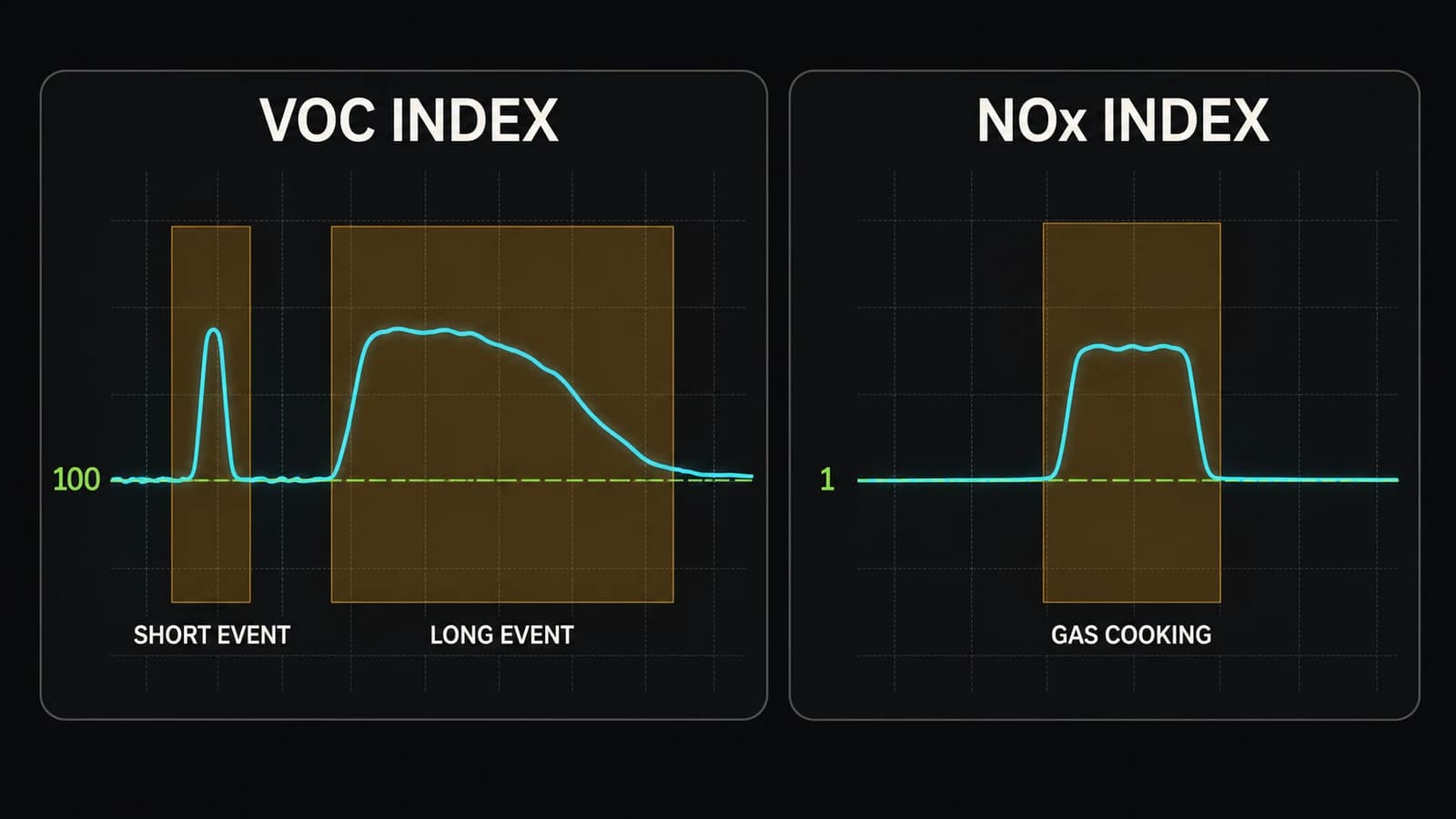
VOC Index and NOx Index are unitless, relative signals. They compare the room's current gas conditions with the sensor's recent history. On the default Sensirion scale, VOC background is centred on 100 and NOx background on 1. A rise marks a change worth investigating, not a concentration or toxicity score.
| Reading | Learned reference | What a rise can tell you | What it cannot tell you |
|---|---|---|---|
| VOC Index | 100 | The sensor is responding more strongly to VOC-type reducing gases than its recent background. | Which VOC is present, its concentration, or how harmful the mixture is. |
| NOx Index | 1 | The sensor is responding more strongly to NOx-type oxidising gases than its recent background. | An exact NO₂ concentration, a definite source, or whether a health limit has been crossed. |
Both indices use a 1-500 scale. The matching top number is a design choice, not evidence that VOC 200 and NOx 200 represent the same amount or risk.
These indices are not the AQI in your weather app
The word index invites an easy mix-up.
Air Quality Index, or AQI converts measured pollutant concentrations into health-communication categories. The VOC and NOx indices compare a small indoor sensor's current response with its own learned background.
VOC Index 100 therefore does not mean the same thing as an outdoor AQI of 100. One means “typical relative VOC conditions for this sensor.” The other belongs to a public outdoor-air reporting system.
What VOC and NOx mean
VOC covers a large and varied family
VOC stands for volatile organic compound. These are carbon-containing chemicals that can evaporate into the air under normal indoor conditions.
Paints, cleaning products, disinfectants, adhesives, furnishings, stored fuels and hobby materials can release VOCs. Cosmetics, cooking and human activity can add some too.
The category alone cannot predict risk. Ethanol, limonene, formaldehyde and benzene can all sit under the broad VOC label, yet they have different properties and health effects. A broadband consumer sensor cannot sort that mixture into named compounds.
NOx points towards oxidising gases
NOx is shorthand for nitrogen oxides, especially nitric oxide and nitrogen dioxide. Indoor sources include gas stoves and unvented fuel-burning heaters. Outdoor traffic air can bring nitrogen oxides through an open window or ventilation intake.
The SEN66 gas channel responds to a broad class of oxidising gases. Nitrogen dioxide is an important target, but ozone and other cross-responses can affect the signal. A NOx rise is therefore a clue about an event, not chemical identification.
Nitrogen dioxide can irritate airways and aggravate respiratory disease. Researchers base those health findings on measured concentration and exposure time. A relative NOx Index cannot be compared with a NO₂ guideline expressed in micrograms per cubic metre.
How the SEN66 turns a gas change into an index
Aura AQ receives its standard VOC and NOx indices from the Sensirion SEN66.
The gas sensor uses metal-oxide, or MOx, technology. A heated metal-oxide surface changes electrical resistance as the surrounding gas mixture changes. Reducing gases, which include many VOCs, affect one broad response. Oxidising gases, which include nitrogen oxides, affect another. Humidity also changes MOx behaviour, so the sensor applies compensation.
Sensirion's Gas Index Algorithm then turns the raw resistance signals into two limited scales. Sensirion uses a relative output because a small broadband MOx sensor cannot maintain laboratory-grade selectivity in a real room full of changing gas mixtures.
The indices are useful for three practical jobs:
- noticing that an event started;
- showing how long the response lasts;
- showing whether extraction or ventilation brings the signal down.
The monitor is not a miniature gas chromatograph. The simpler display has no hidden chemical identity behind it.
Why VOC background is 100 and NOx background is 1
The two indices learn the room differently.
VOC Index: typical recent conditions map to 100
The VOC algorithm uses the sensor's recent history, with a moving 24-hour learning period, to estimate a typical background. It maps that background to 100.
- Above 100 means the VOC response is stronger than the learned background.
- Below 100 means the response is weaker than the learned background.
- Near 100 means conditions resemble what the algorithm has recently learned as typical.
Typical is the important word. It does not mean clean, healthy or free of hazardous VOCs.
The algorithm also adapts its gain. This keeps smaller events visible in rooms with different backgrounds, but it creates a limitation: a source that continues for hours can start becoming part of the learned baseline. Sensirion's technical explanation shows the VOC signal beginning to move back towards average after about three hours during a very long event.
A newly painted room can return towards 100 while the paint is still curing. The monitor may have adjusted its idea of normal even though the vapours remain.
NOx Index: the learned offset maps to 1
The NOx algorithm maps its recent offset to 1. A value above 1 means the oxidising-gas response has increased relative to recent conditions.
NOx events are often discrete, so this algorithm does not use the same gain adaptation as the VOC Index. Even so, 1 is still a relative reference. It should not be translated as “zero NO₂.”
Why you cannot convert the index to ppm or ppb
A concentration answers a physical question: how much of a particular substance exists in a volume of air? It may use ppm, ppb or micrograms per cubic metre.
An index reading answers a different question: how strong is this broadband sensor response compared with its recent history?
There is no valid field conversion that turns VOC Index 180 into 180 ppb, or NOx Index 40 into a nitrogen dioxide concentration. The index is adaptive, the scale is processed, and each gas mixture produces a different sensor response.
Sensirion documents a separate method for deriving an estimated TVOC output from SEN66 raw signals for particular building-standard workflows. That method is not a conversion of the displayed VOC Index and does not make the sensor selective to individual chemicals.
Two monitors can follow the same event while showing somewhat different index values. The current SEN66 datasheet allows more device-to-device variation for NOx than for VOC. Timing and direction often matter more than arguing over a few points.
Four patterns you may recognise at home
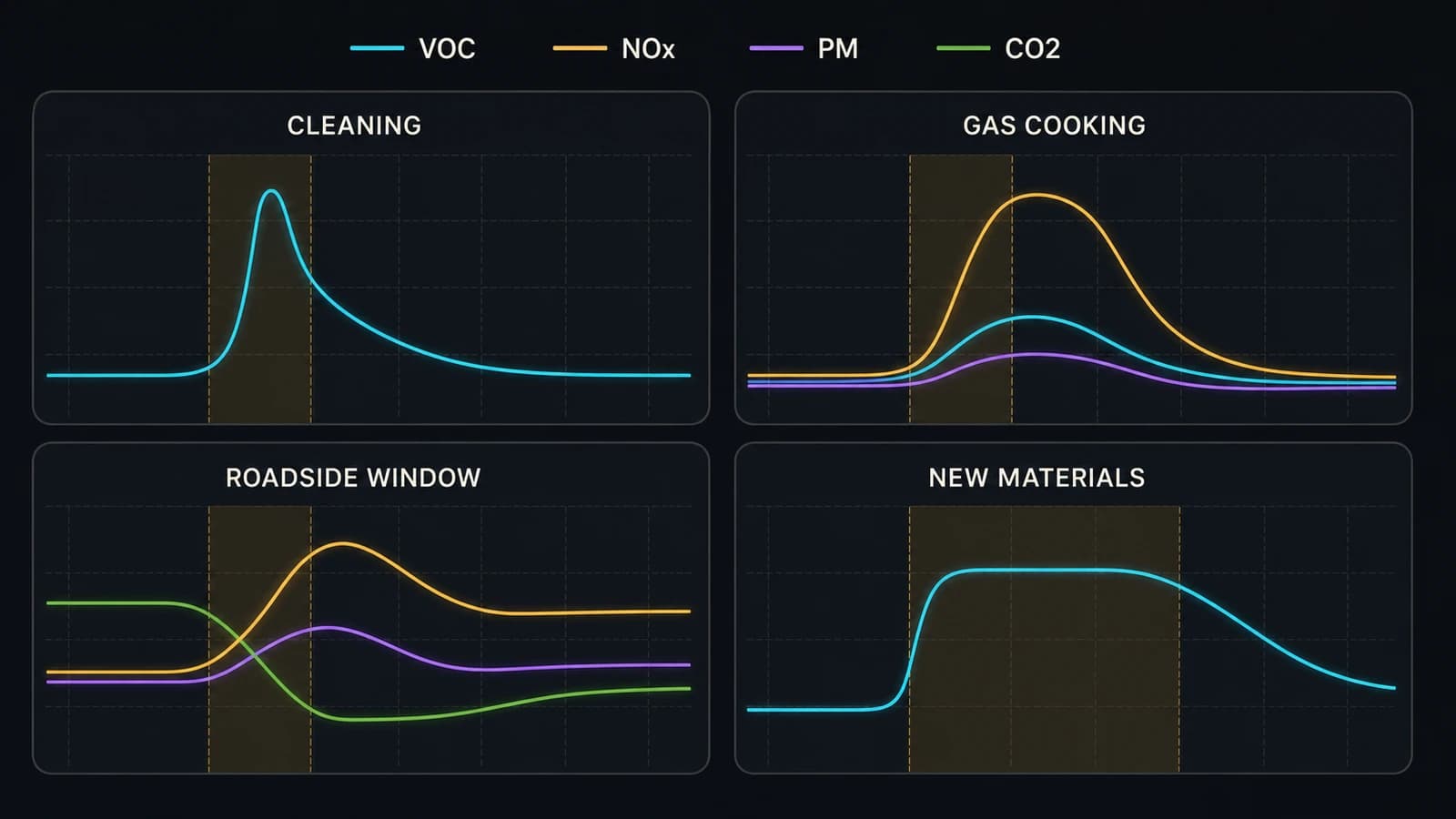
Cleaning moves VOC while NOx stays quiet
Many cleaning products and disinfectants contain volatile alcohols, solvents or fragrances. A strong VOC rise during use is therefore plausible. Direct spray near the monitor can create an exaggerated local event, so the timing tells you more than the peak number.
Check what product was used, stop spraying, follow its label, and run suitable extraction or ventilation. Never mix cleaning products to create a “test.”
Gas cooking moves NOx, often with other channels
A gas flame can produce nitrogen oxides. Cooking also releases particles and organic vapours from heated food and oil, so NOx, VOC and PM may move together.
The combined pattern helps you check whether an outdoor-vented cooker hood clears the event. It cannot identify a recipe or calculate NO₂ exposure. The particle guide explains why cooking can change several PM channels at the same time.
Opening a roadside window improves one reading and worsens another
Opening a window can lower indoor CO₂ while allowing traffic-related NOx or particles inside. One green tile cannot describe the whole room.
Compare the gas indices with particles, the CO₂ ventilation trend, the time of day and trusted local outdoor-air information. Ventilation is a decision about both indoor and outdoor conditions.
New furniture or decorating creates a long VOC response
Paint, adhesive, flooring and composite furniture can release VOCs over hours, days or longer. The VOC Index may show a sustained rise, then move back towards its learned background even while off-gassing continues.
The index can help compare the room before and after source removal or ventilation. It cannot tell you that the source is formaldehyde. Aura AQ treats formaldehyde as a separate optional sensing channel for that reason.
Read the event before you read the number
A useful interpretation starts with four questions:
- What changed in the room? Look for cleaning, cooking, decorating, a new material, an open window or a fuel-burning appliance.
- Which channels moved? VOC alone suggests a different event from NOx rising with particles and CO₂ changing at the same time.
- How long did it last? A brief local spray is different from a response that remains elevated all afternoon.
- What made it fall? Source removal, outdoor-vented extraction, ventilation or suitable gas filtration should produce a visible response if the action addresses the event.
Keep the monitor in one representative position while comparing events. Moving it beside a hob, window or spray bottle changes the question from “what is happening in the room?” to “what is inside this local plume?” Both can be useful, but they are not the same measurement.
After power-up, give the gas channels time to settle. Under the current SEN66 test conditions, strong VOC raw events can be detected in under 60 seconds and NOx raw events in under 300 seconds. The VOC Index reaches its specified behaviour in under one hour; NOx can take up to six hours. Treat the first readings as warm-up and baseline learning after moving or restarting the monitor.
What to do when an index rises
- Find and stop the source if you can. Cap the solvent, pause the spray, stop the combustion process or move a curing material to a better-controlled area.
- Capture pollution where it starts. An outdoor-vented cooker hood or proper local workshop extraction is more effective than trying to clean the whole room afterwards.
- Ventilate when outdoor air makes sense. Traffic pollution, wildfire smoke and high outdoor ozone can change the trade-off.
- Use the right filter for the job. HEPA filters remove particles; gases need activated carbon or another gas-phase medium. Gas-filter performance depends on the material, its amount, airflow, the gas mixture and saturation.
- Watch the decay. A falling trend shows that removal is gaining on the source. A flat or rising line means the source continues, the action is too weak, or outdoor air is adding pollution.
- Read the other channels. The best response considers particles, CO₂, temperature and humidity alongside the gas indices.
No portable cleaner removes every indoor pollutant. A thin carbon sheet should not be treated as unlimited gas protection, and a recirculating split air conditioner does not automatically bring in outdoor air.
If you smell fuel, see smoke, receive a certified carbon-monoxide or smoke alarm, or anyone develops acute symptoms, leave the area and follow local emergency guidance. Do not wait for VOC or NOx index behaviour to confirm a hazard.
What the monitor cannot tell you
The standard VOC and NOx channels cannot:
- name a chemical;
- report an exact VOC, NO₂ or total gas concentration;
- convert an index into ppm, ppb or micrograms per cubic metre;
- prove that a room is healthy because the value looks ordinary;
- measure formaldehyde as a separate compound;
- detect carbon monoxide as a certified alarm;
- replace professional exposure testing, a smoke alarm or any required life-safety device.
Aura AQ is an environmental monitor. Its optional HCHO and carbon-monoxide channels add more focused telemetry, but they do not turn the device into a laboratory analyser, medical device or certified emergency alarm.
Five common index mistakes
“VOC Index 200 means twice as much VOC as 100.”
No. The scale is processed, adaptive and relative. A value of 200 marks a stronger event than the learned background, not a two-times concentration ratio.
“A VOC Index below 100 proves the air is good.”
It only means the current broadband VOC response is below the recent learned background. The sensor may respond weakly to a particular compound, or a chronic source may already be part of the baseline.
“NOx Index is another way to display NO₂ concentration.”
It is a relative oxidising-gas signal. It cannot be converted to a measured NO₂ concentration or compared with a health guideline.
“The monitor can tell cleaning fumes from benzene.”
The room context may make a source plausible, but the sensor cannot identify the molecule. A cleaning event and a fuel-related event can both affect a broadband VOC channel.
“Any purifier will lower both indices.”
A particle-only HEPA purifier does not remove gases. A purifier needs suitable gas-phase media, enough of that media, and replacement before saturation. Source control and outdoor-vented extraction usually come first.
Frequently asked questions
What is a normal VOC Index?
With Sensirion's default algorithm, 100 represents the average VOC background learned from the sensor's recent history. It is a relative reference, not a universal clean-air target.
What is a normal NOx Index?
The NOx algorithm maps its learned offset to 1. A rise above 1 means a stronger oxidising-gas response than the recent background. It does not prove a particular nitrogen dioxide concentration.
Why did cleaning make the VOC Index jump?
Cleaning products can release volatile alcohols, solvents and fragrances. The MOx sensor responds to many of them. Timing can connect the event with cleaning, but the reading cannot identify the ingredients.
Why did cooking change both VOC and NOx?
Gas combustion can produce nitrogen oxides, while heated food and oil release organic vapours and particles. Several channels can therefore move during one meal.
Can I convert VOC Index to ppb?
No. The displayed index is an adaptive relative score. It is not a concentration and has no valid one-step conversion to ppb, ppm or micrograms per cubic metre.
Does a VOC Index detect formaldehyde?
The broadband sensor may respond to formaldehyde, but it cannot separate that response from other VOCs. The VOC Index must not be reported as a formaldehyde measurement.
Does NOx Index detect carbon monoxide?
No. Carbon monoxide is a different gas and needs a suitable dedicated sensor. Use certified carbon-monoxide alarms wherever local guidance requires them.
Will a HEPA purifier lower VOC or NOx?
HEPA media removes particles, not gases. Gas removal requires activated carbon or another gas-specific medium. Performance varies, and no consumer cleaner removes every indoor gas.
Why are the readings unusual after startup?
The heated gas sensor and adaptive algorithms need time to stabilise and learn their background. VOC becomes useful sooner than NOx, which can take several hours to reach its specified behaviour.
The useful habit: treat the index as a clue
You do not need to decode every molecule to learn from the room. Mark what happened, watch which channels moved, change one sensible thing and see whether the trend responds.
Use that feedback loop to check a cleaning plume, weak kitchen extraction or polluted outdoor air entering at rush hour. The index can show change and response; it cannot certify the room.
Explore the other Aura Blog measurement guides.
Sources and further reading
This guide prioritises current manufacturer documentation and official public-health guidance. Links were accessed on 6 August 2026.
- Sensirion: SEN66 environmental sensing platform
- Sensirion: SEN6x datasheet, version 0.92
- Sensirion: What is Sensirion's VOC Index?
- Sensirion: What is Sensirion's NOx Index?
- Sensirion: What is a metal-oxide sensor?
- Sensirion: Why MOx output does not map directly to a norm
- Sensirion: VOC Index for Experts
- US EPA: Volatile Organic Compounds' Impact on Indoor Air Quality
- US EPA: Nitrogen Dioxide's Impact on Indoor Air Quality
- US EPA: Guide to Air Cleaners in the Home
- WHO: Types of air pollutants and their health impacts
- WHO: Global Air Quality Guidelines 2021
- UK Government: Indoor Air Quality Guidelines for selected VOCs
- AirNow: Air Quality Index basics
Educational information only. Aura AQ is not a medical device, laboratory analyser, regulatory instrument, smoke alarm or certified life-safety system.